Limits on $\mathbb{R} \to \mathbb{R}$ Functions
There are many more things that it will be appropriate to study about limits in due time. For instance we have not gotten to a serious discussion of series, which are sequences defined so that each $n$'th element is a sum of the first $n$ elements of some other sequence. Later in the chapter we will also discuss limits of sequences in higher dimensions or on abstract spaces. But studying limits on series is in many ways similar to studying limits on sequences, only with the additional structure that a series is defined by some other sequence which may have its own noteworthy properties. And limits of sequences in higher dimensions or abstract spaces, while a huge topic which we will spend much time on, will ultimately become a meditation moreso on the properties of spaces than a wholly new way that we think about limits.
In that way at least, this section may be considered the apex of our discussion of limits. Here we move from limits on sequences, which we had previously discussed as standing in for 'paths', and we move to studying limits on the paths themselves. Or rather, we will finally study limits on functions. These are exactly the limits that will make possible almost all discussion of derivatives in various forms of calculus, and many of our notions of integrals.
We require a reframing though. When we studied sequences, we studied a path that is counted (i.e. a path that takes steps $x_1$, $x_2$, etc.), and we considered a notion of infinity in "what happens to this sequence when we count on forever?" i.e. we put our infinity, the infinity in $\lim_{n\to\infty}$ at the end of the counting numbers. What a notion of limits on functions will allow us to do is to study what happens when a function goes infinitely close to a point. It will become possible to ask in some cases "what is a function $f$ at point $p$ for which $p$ is not a valid input?"
In another manner of thinking, this is where we conclude part of our discussion about infinity. I went to great lengths to emphasize previously that there is no way for infinity or infinitessimals to be real numbers, and yet it is obviously possible to define a notion of orderings of infinity or infinitessimals. That is, we can simply 'say' that there is some object $\infty$ and it has the property that for all $x\in \reals$ (or $n \in \mathbb{N}$ for that matter) it satisfies $x < \infty$; this is valid, so long as we remember that it is not a real number, and so it also cannot participate in real number arithmetic (there is no intrinsic definition for $a + \infty$ for instance, but we can choose $a + \infty = \infty$ if it is appropriate in context).
When one insists on asking "what is the largest natural number" such an object is immediately called upon; the infinity is nonsensical within the context of the natural numbers, but if we insist on pointing to it as a thing that exists, we merely say $\infty \notin \mathbb{N}$ and thus expect that it does not obey the other properties of natural numbers. What is interesting about real numbers is that we are similarly faced with this problem when we discuss open sets. An open interval $(a,b)$ also has the problem that you cannot say it has a largest element. You might try to gesture at $b$, but by definition $b \notin (a,b)$, since open intervals exclude their endpoints. Of course, we have the can take the supremum, $\sup (a,b) = b$, but in doing so you escape the set you are speaking about, and moreover we cannot use the supremum on unbounded sets such as the whole $\mathbb{N}$ or $\reals$ themselves. But this tells us that the excluded endpoints of an open set actually have a lot in common with the excluded infinities of number system sets, different only in that the number excluded is in fact real and can be examined arithmetically.
So following our discussion from the previous section, what limits of functions will allow us to do is to find the limit points of sets which are the images of functions (outputs), corresponding to limit points of the function's domain (input set).
1. Limits of Functions Definitions
It is typical to begin a discussion of limits of functions with what is commonly referred to as the 'epsilon-delta' limit, which we will get to shortly. However, since we spent the last section coming to an understanding that limits are intrinsically topological, i.e. intrinsically about whether we can find an open set with some special property, I think we'll get some value out of leveraging this understanding and installing it as the primary intuition underlying the limit.
Let $f\colon \reals \to \reals$ be a function. We say that $f$ has limit $L \in \reals$ at point $p\in \reals$ if:
for any open set $V \subset \reals$ around $L \in V$,
there exists an open set $U \subset \reals$ around $p \in U$ such that $$\begin{gather*}
f(U) := \{f(u) \mid u \in U\} \subseteq V
\end{gather*}$$
i.e. the image (the output set) of $U$ is contained in $V$. If this is the case then we write $$\begin{gather*} \lim_{x \to p} f(x) = L \end{gather*}$$ and say that $f$ converges to $L$ at $p$.
This definition is not very useful practically, as implied in its title as a characterization of trivial function limits. That is because we have defined it to work only for functions which take any number as an input, but we have done so because it will be easier here to see what the intuition should be.
Imagine our previous limits in the following way: we say that a sequence converges if for any open set $V \subset \reals$ there exists a natural number open interval $(N,\infty)_\mathbb{N}$ (this is nonsensical since intervals do not exist in countable sets, but lets imagine for a moment that $(N,\infty)_\mathbb{N}$ is just the natural numbers component of the real interval $(N,\infty)_\mathbb{N} := (N,\infty)_\reals \cap \mathbb{N}$) such that the sequence $(a_n)_{n\in \mathbb{N}}$ as a function $a\colon \mathbb{N} \to \reals$ satisfies $a\big((N,\infty)_\mathbb{N}\big) \subset V \subset \reals$. This is exactly our topological sequence limit, that every counting number $n$ after some $N$ corresponds to a sequence element $a_n$ in our $V$. Using this analogy, the function limit is, morally, exactly the same. All we have changed is the domain $\mathbb{N}$ of $a\colon \mathbb{N} \to \reals$ to $\reals$ for $f\colon \reals \to \reals$, and moved the point of convergence from infinity to $p\in \reals$.
The core of the limit is simply that for any (sufficiently small) open set around a point we want to converge around, we need only guarentee that a (sufficiently smaller) open set exists in the set of inputs ($\mathbb{N}$ for sequences, $\reals$ for functions) which has its image in the open set around our convergence point. Of course, infinity is not actually in the natural numbers, but we can in a sense speak of an 'open set around $\infty$' by speaking of all $n > N$, and a similar thing applies for functions, a consideration that is not present in this trivial function limit definition.
The simplest way to speak of what we want is this: imagine a function $f(x) = \big(x(x-1)\big)/(x-1)$. One may quickly observe this simplifies to $x$, canceling the $x-1$ as it were. But if we are to treat the function as seriously defined this way, we must acknowledge that even though it should simplify to $x$, it is nonetheless not defined at $x=1$ since we have a divide by zero at $x=1$. The function is then equivalent to $$\begin{gather*} f\colon (-\infty,1) \cup (1,\infty) \to \reals, \\[0em] f(x) = x \end{gather*}$$ where it is equal to $x$ but only on the ranges negative infinity to $1$ and 1 to infinity, excluding $1$, the point where it is not defined. We want our limit to never explicitly ask what $f(1)$ is, but still to use the surrounding information that $f(x)$ is '$x$ shaped' to conclude $\lim_{x \to 1} f(x) = 1$. Our resulting definition is just as the above trivial definition, but with various obfuscating qualifiers to ensure we never ask for $f(p)$ when $p$ is not in $f$'s domain.
Let $f \colon A \to \reals$ be a function where the domain $A \subset \reals$ has limit point $p \in \reals$. We say that $f(x)$ has limit $L \in \reals$ as $x \to p$ if:
for any open set $V \subset \reals$ around $L \in V$,
there exists an open set $U \subset \reals$ around $p \in U$ such that $$\begin{gather*}
f\big((U \cap A) \setminus \{p\} \big) := \{ f(u) \mid u\in U, u\in A, u \neq p\} \subset V
\end{gather*}$$
i.e. the image of the set of points in both $U$ and $A$ which exception to $p$ itself is contained in $V$.
If this is the case we write $\lim_{x\to p} f(x) = L$ and say that $f$ converges to $L$ at $p$.
This version of the limit will actually be useful to us, but as you can see, the mess of symbols is only particularly illustrative of what the limit is doing when we aren't hedging against the risk of asking what $f(p)$ is. In fact you can see that this definition of the limit is almost exactly the same as above, except that instead of asking that $p$ is in the domain, we merely ask that it is a limit point of the domain, and then we say both that we're only interested in the part of $U$ actually in our domain $A$, and we don't want $p$ included. To exclude $p$, we use the set-minus notation introduced in the previous chapter to, in a sense, subtract all elements of some other set, which is in this case just the singleton set containing only $p$.
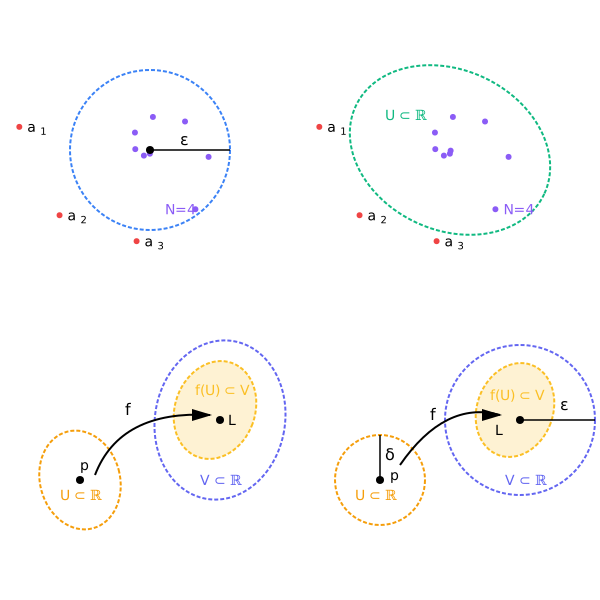
We'll show convergence of our $f(x) = \big(x(x-1)\big)/(x-1)$ example shortly, but before we do, we should describe a version of this limit that's a little easier to use. As seen in the diagram above, just like we showed that epsilon-N limits for sequences are merely a special case of choosing intervals (displayed as circles) centered on our limits as our open sets in a topological limit, we can do the same for function limits. This will allow us to prove our limits using orderings instead of set membership.
Let $f\colon A \to \reals$ be a function where the domain $A \subset \reals$ has limit point $p\in \reals$. We say that $f(x)$ has limit $L\in \reals$ as $x \to p$ if
for all $\varepsilon > 0$ there exists $\delta > 0$ such that for all $x \in A$
that satisfy $|x - p|< \delta$, we have $|f(x) - L| < \varepsilon$.
The obvious way to translate this limit definition into the language of the topological limit is to say $U = (p - \delta, p + \delta)$ and $V = (L - \varepsilon, L + \varepsilon)$, corresponding to $x \in U$ being the same statement as $|x - p| < \delta$ and $f(x) \in V$ being the same statement as $|f(x) - L| < \varepsilon$. You may also notice that this is roughly the function equivalent of the epsilon-N limit, where we have replaced the role of $n > N \in \mathbb{N}$ with $|x - p|< \delta \in \reals$; i.e. instead of 'the rest of the sequence past some point', we now say 'any part of the domain sufficiently close' has its image under $f$ contained in $V$. Alternatively, we can of course speak of the relaxed limit, saying 'the rest of the sequence past some point and including that point'. We'll quickly prove that all above limits are the same, but if the intuition for this is obvious to you then the following proof is redundant.
Let $f\colon A \to \reals$ be a function where the domain $A \subset \reals$ has limit point $p\in \reals$. Then the following statements are equivalent.
$\displaystyle{\lim_{x \to p} f(x) = L}.$
for any open set $V \subset \reals$ around $L \in V$, there exists an open set $U \subset \reals$ around $p \in U$ such that $f\big((U \cap A) \setminus \{p\} \big) \subset V.$
for all $\varepsilon > 0$ there exists $\delta > 0$ such that for all $x \in A$
that satisfy $|x - p|< \delta$, we have $|f(x) - L| < \varepsilon$(relaxed epsilon-delta) for all $\varepsilon > 0$ there exists $\delta > 0$ such that for all $x \in A$
that satisfy $|x - p| \le \delta$, we have $|f(x) - L| \le \varepsilon$
Proof.
Statements a and b are defined equal since a is merely the symbolic shorthand for the topological limit as defined in funclimsR.2, and as described above it is clear that the topological limit implies the epsilon-delta limit. This proof will show the converse, as well as showing $c$ and $d$ are equivalent.
Presume c, that is, say that for all $\varepsilon > 0$, there exists $\delta > 0$ such that for all $x \in A$ that satisfy $|x-p| < \delta$, we have $|f(x) - L| < \varepsilon$. Now say we are given some open set $V \subset \reals$ around $L \in V$, and we aim to show that there exists an open set $U \subset \reals$ around $p \in U$ which satisfies $f\big((U \cap A) \setminus {p} \big) \subset V$.
Since $V$ is an open set, there exists some $\varepsilon > 0$ such that the interval $(L - \varepsilon, L + \varepsilon)$ is contained in $V$. We'll give this $\varepsilon$ to the epsilon-delta limit which is assumed true, and so we deduce there exists a $\delta > 0$ such that $|x - p| < \delta$ implies $|f(x) - L| < \varepsilon$, or equivalently, $x \in (p -\varepsilon, p + \varepsilon) \cap A$ (any $x$ satisfying that condition which is also valid as an input) implies $f(x) \in (L - \varepsilon, L + \varepsilon)$ which by $(L - \varepsilon, L + \varepsilon) \subset V$ implies $f(x) \in V$. Set $U = (p -\varepsilon, p + \varepsilon)$. Then, by the epsilon-delta limit as described, any $x \in U \cap A$ (and of course this remains true even when $p \notin A$ since it is true for all $x \in U \cap A$ so we are free to also remove $p$ anyway) implies $f(x) \in V$, as required for the topological limit. Stated in terms of set images, we say $f\big((U \cap A) \setminus \{p\} \big) \subset V$, satisfying the topological limit exactly.
We next move to show equivalence between the epsilon-delta limit and the relaxed epsilon-delta limit. First assume the epsilon-delta limit as in c: for all $\varepsilon_1 > 0$ there exists $\delta_1 > 0$ such that for all $x \in A$ that satisfy $|x - p|< \delta_1$, we have $|f(x) - L| < \varepsilon_1$. Our principle challenge is to pick a new $\delta_2$ such that when we are given $\varepsilon_2$, our limit is tolerant to $|f(x)-L| < \varepsilon_1$ instead admitting an equals case $|f(x)-L| = \varepsilon_2$ and $|f(x)-L| < \varepsilon_2$ when $|x - p| \le \delta_2$. So say we are given some $\varepsilon_2 > 0$. Choose $\varepsilon_1 = \varepsilon_2$ so that we imply the existence of a $\delta_1$ with the appropriate properties for an epsilon-delta limit. If we then set $\delta_2 = \delta_1/2$, we have $\delta_2 < \delta_1$, and thus $|x - p| \le \delta_2 < \delta_1$, which by the epsilon-delta limit implies $|f(x) - L| < \varepsilon_1 \le \varepsilon_2$, exactly as required.
The converse proof is similar; assume the relaxed epsilon-delta limit as in d, so for all $\varepsilon_2 > 0$ there exists $\delta_2 > 0$ such that for all $x \in A$ that satisfy $|x - p| \le \delta_2$, we have $|f(x) - L| \le \varepsilon_2$. This time, when we're given a $\varepsilon_1 > 0$ and we need to find a way to satisfy the normal epsilon-delta condition, we'll set $\varepsilon_2 = \varepsilon_1/2$ to induce some $\delta > 0$ via our assumed relaxed epsilon-delta limit, which has the property that $|x - p| \le \delta_2$ implies $|f(x)- L| \le \varepsilon_2$. Since $\varepsilon_2 = \varepsilon_1/2$, we say $\varepsilon_2 < \varepsilon_1$, and thus $|x - p| \le \delta_2$ implies $|f(x) - L| \le \varepsilon_2 < \varepsilon_1$. Since this is true for all $x$ satisfying $|x - p| \le \delta_2$, we also say that this is true for all $x$ satisfying $|x - p| < \delta_2$ by merely choosing not to use the $x$ which satisfies $|x-p| = \delta_2$ (this is like merely noticing that $x \in (p - \delta_2, p+\delta_2)$ implies $x \in [p - \delta_2,p + \delta_2]$ since one is a subset of the other). Setting $\delta_1 = \delta_2$, we have then that $|x-p| < \delta_2 = \delta_1$ implies $|f(x)-L| \le \varepsilon_2 < \varepsilon_1$ as required for the normal epsilon-delta limit.
Below we'll conclude our previously mentioned example, however you'll notice it's ultimately fairly trivial. In fact this will remain the case with most specific examples of function limits until we develop some more sophisticated tools; right now, we only have the ability to manipulate algebraic functions to create such holes in the domain.
Example funclimsR.5—Showing convergence of $\big(x(x-1)\big)/(x-1)$
Let's continue our prior example, although it will quickly become apparent that this is one of the easiest kinds of limits to show. Setting $f(x) = \big(x(x-1)\big)/(x-1)$ and $L = 1$ at $p=1$, showing the limit is to show that for all $\varepsilon > 0$, there exists some $\delta > 0$ such that when $|x - p| = |x - 1| \le \delta$, we have $|f(x) - L| = |f(x) - 1| \le \varepsilon$.
As before, since this function is not defined at $x = 1$, its domain is $(-\infty, 1) \cup (1, \infty)$, so it is not meaningful to speak of $f(1)$. But if this is true, then it is also reasonable to simply cancel the $(x-1)/(x-1)$ component to $1$, since this is possible on all $x \neq 1$. In this case, we are trying to show there exists $\delta > 0$ such that $|x - 1| \le \delta$ implies $|f(x) - L| = |x - 1| \le \varepsilon$.
For any $\varepsilon > 0$ we are given, this is satisfied by simply setting $\delta = \varepsilon$.
2. Continuity, Sequential Characterizations, and Algebraic Theorems
For now, most of what our limits can show us is that functions seem to 'do what we expect'. Most functions we can take limits of right now either have a hole in their domain because we put it there (i.e. insisting a function which is well defined at a point cannot be taken there) or do not converge at all. In the former case, the hole is not even necessary; we may simply take the limit of a function for a point it is defined for, and to great anti-climax, find that it usually converges.
But this is not always the case. Consider the following piecewise function. $$\begin{gather*} H(x) = \left\{ \begin{matrix} -1 & x < 0 \\[0em] 1 & x > 0\end{matrix}\right. \end{gather*}$$ That is, we speak of a function which is negative one when $x < 0$ and one when $x > 0$. This function also has a hole at $x = 0$, which is clearly a limit point of the domain $\reals \setminus\{ 0 \}$ since we obviously may define a sequence $a_n = 1/n$ converging to $0$, so we may take a limit there in theory. In practice, there is no such $L$ that $H$ will converge to at $x=0$. One need only choose $0 < \varepsilon < 1$ and see that suddenly, all open sets $U \subset \reals$ (formed by $|x| < \delta$ or otherwise) containing $0 \in U$ fail to have $H(U \setminus \{0\}) \subset (-\varepsilon, \varepsilon)$, due simply to the fact that $\varepsilon < 1$ will mean that $(-\varepsilon, \varepsilon)$ shrinks into a range which $H$ never goes. You could try fixing this by setting $L = -1$ or $L=1$ but in the former case, any $x=\delta/2$ would violate $|H(x) - L| < \varepsilon$ by $H(x) = 1$ and in the latter, $x=-\delta/2$ violates it since $H(x) = -1$.
What we have encountered is a discontinuity, often described as a place where our pen must disappear off the page before reapparing somewhere else when we want to draw the graph. In fact we could simply choose to define $H(0) = 1$ or $H(0) = -1$, and this problem would remain for exactly the reasons discussed above. We could choose another function $D\colon \reals \to \reals$ which is $D(0) = 1$ and $D(x) = 0$ for $x \neq 0$ instead, since in this case the limit does exist, however it has a similar problem in that its limit at $x=0$ is $L=0$, not the value $D(0)=1$. It turns out that accounting for these sorts of cases is all we need to establish a criterion of continuity, and indeed this will be our first serious application of function limits.
Let $f\colon A \to \reals$ be a function with $A \subseteq \reals$ and $B \subseteq A$.
If for $p \in A$, we have $\lim_{x \to p}f(x) = f(p)$, then we say that $f$ is continuous at $p$.
If for all $p\in B$, $\lim_{x \to p}f(x) = f(p)$, we say that $f$ is continuous on $B$.
If for all $p\in A$, we have $\lim_{x \to p}f(x) = f(p)$, we say that $f$ is a continuous function.
When $f$ is a continuous function, we say that it is a member of the set $f \in C^0(A,\reals)$, often abbreviated $C^0(A)$, the set of continuous functions from $A$ to $\reals$.
We should make the connection we are drawing between paths and sequences explicit. A sequence and a path are clearly not the same thing, and arguments we have used thusfar for sequences do not apply for paths, such as in seqlimsinR.8 where we bounded the 'beginning' of a sequence based on it being finite.
Nonetheless, it is clear that intrinsic to many of the statements we have made about sequence limits is a certain intuition that is appropriate to paths. Now with continuity as a motivation, it is natural to ask whether, for a sequence $(a_n)_{n \in \mathbb{N}}$ with limit $a \in \reals$ and a function $f\colon \reals \to \reals$, we have $\lim_{n\to\infty}f(a_n) = f(a)$. That is, can we test continuity (and perhaps other function limits) with mere sequences, bypassing the need to use function limits at all?
The answer in general is no, but there is indeed a strong link to be made here which will prove invaluable to us. We must strengthen the statement we are aiming for, that is, we cannot merely say that a statement about convergence of sequences implies something about convergence of functions, but we can say that if it is true on all convergent sequences, and we can say the converse.
Let $f\colon A \to \reals$ be a function and $p,L \in \reals$ with $p$ a limit point of $A$. Then the following statements are equivalent:
$\displaystyle{\lim_{x\to p} f(x) = L}$
for all sequences $(a_n)_{n \in \mathbb{N}}$ with $a_n \in A$ and $a_n \neq p$ for all $n \in \mathbb{N}$, and with $a_n \to p$ as $n \to \infty$, we have $\lim_{n \to \infty} f(a_n) = L$.
The following proof will make heavy use of propositional manipulations, so it makes a good example for inspection if that is something you are interested in.
Proof.
Suppose first that $\lim_{x \to p} f(x) = L$, that is, by the relaxed epsilon-delta characterization, that for all $\varepsilon_1 > 0$, there exists $\delta> 0$ such that when $|x - p| \le \delta$, we have $|f(x) - L| \le \varepsilon_1$. If we are given some $\varepsilon_2 > 0$ for a relaxed epsilon-N characterization of the sequence limit, along with an appropriate $(a_n)_{n\in \mathbb{N}}$ with the above guarentees, we must find some $N$ such that for all $n \ge N$, we have $|f(a_n) - L| \le \varepsilon_2$. So set $\varepsilon_1 = \varepsilon_2$ so that our $\delta$ exists with the properties mentioned above. We already know that $a_n \to p$ as $n \to \infty$, so if we treat this as its own relaxed epsilon-N limit and set $\varepsilon_3 = \delta$, we obtain $N$ such that for all $n \ge N$, we have $|a_n - p| \le \delta$. This is the $N$ we want: for all $n \ge N$, we know $|a_n - p| \le \delta$, but by the relaxed epsilon-delta limit for $f$ we knew that any $x$ (including $x=a_n$) satisfying $|x - p| \le \delta$ satisfies $|f(x) - L| \le \varepsilon_1$. So we conclude $|f(a_n) - L| \le \varepsilon_1 = \varepsilon_2$.
For the converse, we will need some more advanced propositional tools. This proof will be done via proof by contrapositive, so we will show not that "for all sequences $(a_n)_{n\in \mathbb{N}}$ which satisfy etc. we have $\lim_{n \to \infty} f(a_n) = L$" implies $\lim_{x \to p} f(x) = L$, but rather, with those two statements as our $P$ and $Q$ respectively, we will prove $\neg Q \implies \neg P$. Under our various rules of propositional negation, $\neg Q \Rightarrow \neg P$ is the same as $P \Rightarrow Q$. This will also necessitate a careful negation of the full statements, exercising our other rules of propositional negation.
Beginning with the statement that $\lim_{x \to p}f(x) = L$, we will negate the epsilon-delta limit, taking $p$ being a limit point as a given. $$\begin{gather*} \neg \Big( \forall \varepsilon_1 > 0, \exists \delta > 0, \forall x \in A, |x - p| \le \delta \Rightarrow |f(x) - L| \le \varepsilon_1\Big) \\[0em] \Leftrightarrow \exists \varepsilon_1 > 0, \forall \delta > 0, \exists x \in A, \neg \Big(|x - p| \le \delta \Rightarrow |f(x) - L| \le \varepsilon_1\Big) \\[0em] \Leftrightarrow \exists \varepsilon_1 > 0, \forall \delta > 0, \exists x \in A, \big( |x - p| \le \delta \big) \wedge \big( |f(x) - L| > \varepsilon_1 \big) \end{gather*}$$ The final form of this is "there exists $\varepsilon_1 > 0$ such that for all $\delta_1 > 0$, there exists $x \in A$ such that both $|x-p|< \delta$ can be true while $|f(x) - L| \ge \varepsilon_1$ (i.e. violating the bound that is appropriate for a limit) is also true". This should make sense to us as the negation, since the first three quantifiers negate as 'for all' turning into a search for an exception, and 'there exists' turning into a proof that there are no counter examples. The negation of the final implication should also make sense to us, as explained in proptypes.19, since an implication $P \Rightarrow Q$ can be shown false if we find an instance where both $P$ was true and $Q$ was not true.
The second statement we need to negate ought to be negated in two parts. We have the statement of the sequential limit itself, an the statement around the limit. The former will follow similarly as above. $$\begin{gather*} \neg \Big( \forall \varepsilon_2 > 0, \exists N \in \mathbb{N}, \forall n \in \mathbb{N}, (n \ge N) \implies \big( |f(a_n) - L| \le \varepsilon_2 \big)\Big) \\[0em] \Leftrightarrow \exists \varepsilon_2 > 0, \forall N \in \mathbb{N}, \exists n \in \mathbb{N}, \neg \Big( (n \ge N) \implies \big(|f(a_n) - L| \le \varepsilon_2 \big) \Big) \\[0em] \Leftrightarrow \exists \varepsilon_2 > 0, \forall N \in \mathbb{N}, \exists n \in \mathbb{N}, (n \ge N) \wedge \big( |f(a_n) - L| > \varepsilon_2 \big) \end{gather*}$$ This will form the statement $\neg \left( \lim_{n \to \infty} f(a_n) = L \right)$. The statement it exists within is the following: $$\begin{gather*} \forall \left( (a_n)_{n\in \mathbb{N}}, \left( \lim_{n \to \infty} a_n = p\right) \wedge \big( \forall n \in \mathbb{N}, (a_n \in A) \wedge (a_n \neq p) \big)\right), \lim_{n \to \infty} f(a_n) = L. \end{gather*}$$ The reason for the unusual format is that it is not enough to say here that 'for all sequences etc.' we must enforce that our statement only holds when we say 'for all' for sequences that follow specific conditions, namely that they must converge to $p$, and that for all $n \in \mathbb{N}$, they satisfy $a_n \in A$ and $a_n \neq p$. Consequently, the formal statement calls for not a sequence of nested 'for all's and 'there exists' statements as in the case of a limit, but rather one big for-all in which what must be provided is a pair containing first a sequence and next, all of the relevant propositional evidence that this sequence is satisfactory. Ultimately, we may combine the earlier negation of the limit with negation on this one singular quantifier to obtain the total negative: $$\begin{gather*} \exists \left( (a_n)_{n\in \mathbb{N}}, \left( \lim_{n \to \infty} a_n = p\right) \wedge \big( \forall n \in \mathbb{N}, (a_n \in A) \wedge (a_n \neq p) \big)\right), \neg \left( \lim_{n \to \infty} f(a_n) = L \right) \end{gather*}$$ This statement can now be read "for some sequence $(a_n)_{n\in \mathbb{N}}$ which converges to $p$ and satisfies that for all $n \in \mathbb{N}$, both $a_n \in A$ and $a_n \neq p$, $\big(f(a_n)\big)_{n\in \mathbb{N}}$ will fail to converge to $L$ as $n \to \infty$".
We are finally ready to proceed to the actual proof, which will be to the effect that: if all sequences obeying the conditions described imply $f(a_n) \to L$ as $n \to \infty$ then $\lim_{x \to p}f(x) = L$ since we can show that if $\lim_{x \to p} f(x) = L$ is not true, then it was because there existed a counter example sequence obeying the necessary conditions in which $f(a_n)$ failed to converge to $L$.
We begin with the assumption that $\neg(\lim_{x \to p} f(x) = L)$, i.e. that there exists some $\varepsilon_1 > 0$ such that for all choices of $\delta_1 > 0$, there will exist a $x \in A$ which is both $|x- p| < \delta$ and $|f(x) - L| \ge \varepsilon_1$. Take $\varepsilon_1$ to exist as presumed. Since our statement now provides a 'for all' in $\delta$, let us choose a sequence of deltas assigned $(\delta_n)_{n\in \mathbb{N}}$ where $\delta_n = 1/n$. Since our hypothesis holds for all $\delta_n$, we also say that each $\delta_n$ has some $x_n$ such that both $|x_n - p| < \delta_n$ and $|f(x) - L | \ge \varepsilon_1$, so we'll define a sequence of these too called $(x_n)_{n\in \mathbb{N}}$.
Our goal now, as previous discussed, is to find a sequence $(a_n)_{n\in \mathbb{N}}$ which converges to $p$, is never $p$, and is always in $A$, for which $\lim_{n \to \infty} f(a_n) = L$ fails to hold, and we claim that $(x_n)_{n\in \mathbb{N}}$ is this sequence. In order for $(x_n)_{n\in \mathbb{N}}$ to be applicable however, we must first show that it converges to $p$; we already know by construction that each $x_n\in A$, and we can guarentee that $x_n \neq p$ since it is defined $|f(x) - L| > \varepsilon_1$, which may not be possible if $x_n = p$ (if $p$ is in the domain however, a version of this argument is readily constructed which drops the $a_n \neq p$ for all $n\in \mathbb{N}$ condition, so without loss of generality, assume $x_n \neq p$ because $p \notin A$).
To show $(x_n)_{n\in \mathbb{N}}$ converges to $p$, say we are given $\varepsilon_3 > 0$ in accordance with a relaxed epsilon-N limit. It suffices to choose $N = \lceil 1/\varepsilon_3 \rceil$ since we already know that $|x_n - p| \le \delta_n = 1/n$, so by similar reasoning as in example seqlimsinR.3, we know for all $n \ge N = \lceil 1/\varepsilon_3 \rceil$, we satisfy $|x_n - p| \le \delta_n \le \varepsilon_3$.
Now, we finally show the negated limit, i.e. prove $\neg(\lim_{n \to \infty} f(x_n) = L)$. We must show there exists a $\varepsilon_2 > 0$ such that for all $N \in \mathbb{N}$, there exists a $n \in \mathbb{N}$ such that both $n \ge N$ and $|f(x_n) - L| > \varepsilon_2$ may be true. Take $\varepsilon_2 = \varepsilon_1$, the epsilon we already know exists by hypothesis. Now presume we are given some $N \in \mathbb{N}$ in accordance with the following 'for all' quantifier. Remembering that each $x_n$ was defined to have the property that $|x-p| \le \delta_n$ and $|f(x) - L| > \varepsilon_1$, and we now have $\varepsilon_2 = \varepsilon_1$, we have that all $x_n$ satisfy $|f(x_n) - L| > \varepsilon_2$ as desired. We need only show that this is true for some $n \ge N$, but since it is true on all $n$, it suffices to pick any valid one.
We are done.
From the perspective of the development of a theory, this connection is remarkable, and in a sense, exactly what we hope for in mathematics. We are now in a position to extend many of our theorems about sequence limits to function limits.