Sequences and Limits in $\mathbb{R}$
Here we can begin to substantiate at least one notion of what happens at infinity, in so far as you could ever say that, which, for our formal purposes, I will continue to say we cannot. In fact, one could execute a proof of the Archimedian property from the previous section in the opposite manner, showing not that there exist no infinitessimals in the reals but no infinity objects in $\reals$. So infinity believers are in a rough spot right now. We certainly know what we mean informally when we want to discuss infinity, but we cannot actually do so without producing contradictions via the Archimedean property. It is perhaps one of the motivations of real analysis that we are able to construct ways to launder infinity into our work.
Before we are ready to use infinity to speak of things infinitessimally close to a point however, it will be easier to develop our conceptions and mathematical tools if we focus on the simplest kind of infinity first, not an infinity we imagine in $\reals$ (or indeed an infinitessimal), but an infinity in $\mathbb{N}$. This is no mere building block either; we will continue to use limits of countable sequences for probably the entirety of this text since they provide an alternate, often simpler, way to prove things or make statements.
Our notion of 'what is at infinity' will be defined not as a literal infinity but as what happens 'on the way there'; consequently it will be easier to speak about 'on the way there' if the process of 'going there' is a countable one, i.e. we will work with sequences instead of paths.
1. Formal Definitions
A sequence is an ordered set of real numbers indexed by $\mathbb{N}$, or equivalently, it is a function $a: \mathbb{N} \to \reals$ which we write $(a_n)_{n \in \mathbb{N}}$ and denote elements of the ordered set (or equivalently outputs of the function) as $a_n$ for the corresponding counting number $n$.
Sometimes (and in some math texts) we use $a_n$ with $n$ completely unspecified as a shorthand to refer to the whole sequence $(a_n)_{n\in \mathbb{N}}$.
We say that a sequence $(a_n)_{n \in \mathbb{N}}$ converges to $a \in \reals$ or 'has limit' $a \in \reals$ if the following is true:
for all $\varepsilon > 0$, there exists $N \in \mathbb{N}$ such that for all $n \ge N$, we have $|a_n - a| \le \varepsilon$.
This condition is often formally written: $$\begin{gather*} \forall \varepsilon > 0, \hspace{0.1em} \exists N \in \mathbb{N}, \hspace{0.1em} (n \ge N) \Rightarrow \big(|a_n - a| \le \varepsilon \big). \end{gather*}$$
When the sequence converges to $a$, we write $$\begin{gather*} \lim_{n \to \infty} a_n = a \end{gather*}$$ or say that $a_n \to a$ as $n \to \infty$. (The symbol $\varepsilon$ is the greek letter 'epsilon'.)
Personally I found the statement for the requirement of a limit quite difficult to parse the first time I saw it, not having been practiced at proposition heavy mathematics. And especially I was frustrated that I did not see why this seemingly arbitrary requirement had anything to do with infinity. I hope that the following description will mean you share no such grievance.
First, the limit requirement. The way this is to be read is thus. Imagine I gave you a sheet of metal and I told you, "hey, I found this sheet of metal, and it's perfectly smooth". You're suspicious, so you run your finger over it and feel that it is smooth, meaning that it appears perfectly smooth at least to the detection standard of your fingers, which are not very precise instruments. So you're still suspicious, and you get a magnifying glass and look it over for imperfections, and you still find none. Next, you get a microscope, and under the microscope, the sheet of metal still appears to be perfectly smooth. It is not that you need to view the atomic structure of the sheet to know that it is perfectly smooth, but in particular that you know it is perfectly smooth once you can trust that "no matter how closely I look, my measuring device will always tell me the sheet is smooth". This is our definition of 'perfect' here; that the property remains true no matter how much more precision you use to check if the property holds.
The definition of the limit is exactly the same as above, but instead of perfect smoothness we are saying that the sequence becomes perfectly close to $a$.
I tell you that $(a_n)_{n \in \mathbb{N}}$ converges to $a$. You're suspicious, so you pick some measuring threshhold $\varepsilon \in \reals$ which is $\varepsilon > 0$, and you ask me if I can find some point in the sequence where the entire sequence after that point is less than $\varepsilon$ away from $a$. That is, you ask me to find some $N \in \mathbb{N}$ such that for all $n \ge N$, we satisfy $|a_n - a| \le \varepsilon$; the condition $n \ge N$ ensures that $a_n$ and all $a_n$ after it is past the point of sufficient closeness. You're still suspicious, so you pick a smaller $\varepsilon$, and once again I am able to find a larger $N \in \mathbb{N}$ for which all $a_n$ with $n$ after $N$ are less than $\varepsilon$ away from $a$. You pick an even smaller $\varepsilon$, but this time, instead of giving you a particular $N\in \mathbb{N}$, I give you a method by which you can find your own $N \in \mathbb{N}$ for any $\varepsilon$. By providing this method, you can trust that no matter how small a $\varepsilon$, there will exist a satisfactory $N$, and you can trust that the sequence converges. This is what it means to prove the limit.
Example seqlimsinR.3—$1/n^2$ goes to $0$ as $n$ goes to $\infty$
Let us show that the sequence $\left(\frac{1}{n^2} \right)_{n \in \mathbb{N}}$ converges to $0$. Observe first that $\left|\frac{1}{n^2} - 0\right| = \frac{1}{n^2}$ since $\frac{1}{n^2}$ is always positive. Moreover, the function (and the sequence it defines) $n \mapsto \frac{1}{n^2}$ is monotonically decreasing as defined in the previous section, meaning that for all $n$, $\frac1{n^2} > \frac1{(n+1)^2}$. (If the reason why in this case is not obvious to you, set $n = 2$ and remember that a quarter of a pizza is larger than a ninth of one. See corollaries at the end of the previous chapter). This means that if we pick $\varepsilon = 1/N^2$, this would satisfy the limit $|1/n^2 - 0| \le 1/N^2$ for all $n \ge N$ since when $n$ is greater than $N$, by the monotonically decreasing property, $1/n^2$ must be smaller than $1/N^2$.
But the whole point of the reasoning of the limit is that we, as the ones proving the limit, cannot pick $\varepsilon$. We must imagine someone else picking $\varepsilon$ and ourselves making a procedure to find $N$ for which $n \ge N$ implies $|1/n^2 - 0| < \varepsilon$. Still, noticing that the limit is satisfied when $\varepsilon = 1/N^2$ helps us, since we can invert this relation. Naively we can take $$\begin{align*} \varepsilon &= \frac{1}{N^2} \\[0em] \frac{1}{\varepsilon} &= N^2 \\[0em] \frac{1}{\sqrt{\varepsilon}} &= N \end{align*}$$ And if this alone worked, then in fact we would be done. Setting $N$ like this would indeed mean that when $n \ge N$ then we have $|1/n^2 - 0| < \varepsilon$. The only trouble is that $N \in \mathbb{N}$ needs to be a counting number, and we have no guarentee that the $\varepsilon$ picked will produce a counting number when we take its inverse squareroot. This is easily solved however by rounding up $1/\sqrt{\varepsilon}$ to the largest whole number, an operation called taking the ceiling and written $$\begin{gather*} N = \left\lceil \frac{1}{\sqrt{\varepsilon}} \right\rceil \ge \frac{1}{\sqrt{\varepsilon}}. \end{gather*}$$ with the property that it is greater than or equal to its counterpart that is not rounded up. Now when we are given some $\varepsilon$ we are able to automatically produce some $N$ for which $n \ge N$ will satisfy $|1/n^2 - 0| \le \varepsilon$.
Let's test this to be certain. Say we are given $\varepsilon$ and thus set $N = \lceil 1/\sqrt{\varepsilon} \rceil$. Since $N$ is rounded up, first and foremost we have $N \ge 1/\sqrt{\varepsilon}$ larger than its unrounded version.
Now consider that since $x \mapsto 1/x$ is a monotonic decreasing function on positive numbers (which $\varepsilon$ is required to be), we deduce from $N \ge 1/\sqrt{\varepsilon}$ that $$\begin{gather*} \frac{1}{N} \le \sqrt{\varepsilon} \end{gather*}$$ flipping the ordering by the monotonic decreasing property in realnumsax.10. We also have that $x \mapsto x^2$ is a monotonic increasing function on positive numbers, so undoing the square root will preserve the ordering. $$\begin{gather*} \frac{1}{N^2} \le \varepsilon. \end{gather*}$$ Recall that the property we wanted out of $N$ was that $|1/n^2 - 0| \le \varepsilon$ was only true when $n \ge N$, so let us operate on that next. Once again, $x \mapsto 1/x$ will flip the sign, and $x \mapsto x^2$ will preserve it. $$\begin{gather*} n \ge N \\[0em] \frac{1}{n} \le \frac{1}{N} \\[0em] \frac{1}{n^2} \le \frac{1}{N^2} \end{gather*}$$ We also had that $|1/n^2 - 0| = 1/n^2$. So together we have a transitivity between equality and addition, $$\begin{gather*} \left| \frac{1}{n^2} - 0\right| = \frac{1}{n^2} \le \frac{1}{N^2} \le \epsilon \end{gather*}$$ implying $$\begin{gather*} \left| \frac{1}{n^2} - 0\right| \le \epsilon \end{gather*}$$ as we had wanted. Notice that we proved this, as we needed to, for any $\varepsilon > 0$ that there exists some $N \in \mathbb{N}$ which for us was $N = \lceil 1/\sqrt{\varepsilon} \rceil$, and if we assumed $n \ge N$ then we could deduce $|1/n^2 - 0| \le \varepsilon$. This is the pattern of a proof of limit.
In general, the pattern of proving a limit is roughly as above; in particular, we first identify how small a $\varepsilon$ a given $N$ can satisfy, which we did when we noticed that $\varepsilon = 1/N^2$ will mean we are trying to prove $n \ge N$ implies $1/n^2 \le 1/N^2$, which we know to be true immediately from the monotonic decreasing property of $x \mapsto 1/x^2$. Next, we treat the earlier relationship $\varepsilon = 1/N^2$ as a function $\varepsilon \mapsto 1/N^2$ and we see if we can invert it, finding either some way to calculate $1/N^2 \mapsto \varepsilon$ or the next best thing; this ended up being our $N \mapsto 1/\sqrt{\varepsilon}$ as our inverse function, and we had to round it up to make it a whole number. Most proofs will omit these steps, since the crux of the proof is not that we can find some relationship but rather that a relationship exists and that it works. So having found our relationship $N = \lceil 1/\sqrt{\varepsilon} \rceil$ we try to in some sense unwrap whatever transformations we've made to the function while taking $n$ along for the journey; that is, we map $n \ge N$ to $1/n \le 1/N$ together, then square them together. At this point, some minor amount of symbolic massaging will generally get you your limit.
Example seqlimsinR.4—$2^{-n}$ goes to $0$ as $n$ goes to $\infty$
Let us repeat the steps we did prior but more streamlined this time. In this case we notice we are studying a strictly monotonic decreasing function $n \mapsto 2^{-n}$ which is always $2^{-n} > 0$, so immediately a condition $|2^{-n} - 0| \le \varepsilon$ can be read instead as $2^{-n} \le \varepsilon$. This may inspire us to take an inverse, and indeed we can notice that if we could choose $\varepsilon = 2^{-N}$ then $n \ge N$ would imply $2^{-n} \le \varepsilon$ as we desire, so we want to propose something like $N = - \log_2 \varepsilon$. The negative sign here is not to make $N$ negative (indeed we do not want this) but instead to make it positive, since a $\varepsilon < 1$ will have $\log_2 \varepsilon \le 0$, a property of logarithms. The problem we actually have is the same as in the previous example, that we have no guarentee that $- \log_2 \varepsilon$ is a whole number, so we will want to round it up as $N = \lceil - \log_2 \varepsilon \rceil$.
With this $N$ proposed, we can now prove the limit. First observe that $$\begin{gather*} N = \lceil - \log_2 \varepsilon \rceil \ge - \log_2 \varepsilon \end{gather*}$$ so we may apply the monotonic decreasing function to the inequality, $x \mapsto -x$, obtaining $$\begin{gather*} - N \le \log_2 \varepsilon \end{gather*}$$ with the appropriate sign flip, followed by $x \mapsto 2^x$ to undo the logarithm (which is a monotonic increasing function), $$\begin{gather*} 2^{- N} \le \varepsilon. \end{gather*}$$ If we repeat these operations on $n \ge N$ we obtain $$\begin{gather*} -n \le -N \\[0em] 2^{-n} \le 2^{-N} \end{gather*}$$ providing the transitive chain $$\begin{gather*} |2^{-n} - 0| = 2^{-n} \le 2^{-N} \le \varepsilon \\[0em] |2^{-n} - 0| \le \varepsilon \end{gather*}$$ completing the proof of the limit.
We could do more examples (and indeed I may have to return here and add more) but the majority of the limits we will prove over this chapter are limits related to other limits. So instead of the particular technique described above, what we will frequently be doing is saying that some sequence $(a_n)_{n \in \mathbb{N}}$ converges to $a$, and that since it does, we can take the existence of the $N$ which it implies and use it to imply that some other sequence $(b_n)_{n\in \mathbb{N}}$ also converges to some $b$.
At the beginning of chapter 1 we discussed the idea of the development of a theory; this involved defining core concepts, sub-concepts, relationships between those concepts, and finally substantiation of the implication of the theory onto other areas of study. We have now defined our core concepts for our theory of limits, and so in line with stage two, we must define sub-concepts and properties.
Let $(a_n)_{n\in \mathbb{N}}$ and $(b_n)_{n\in \mathbb{N}}$ be sequences, and let there exist a monotonic increasing map $\varphi\colon \mathbb{N} \to \mathbb{N}$ (so for all $n > m$ we have $\varphi(n) > \varphi(m)$). If $b_n = a_{\varphi(n)}$ for all $n \in \mathbb{N}$ then we call $(b_n)_{n\in\mathbb{N}}$ a subsequence of $(a_n)_{n\in \mathbb{N}}$. That is, a subsequence is a sequence that skips elements, or that is missing elements.
A subsequence can do a few things for us. We can define a subsequence with $\varphi\colon n \mapsto n + m$ where $m \in \mathbb{N}$ is some number that skips the sequence forwards by a constant. We could have $\varphi\colon n \mapsto 2n$ which would skip every second entry; this is useful in cases like the sequence $\big((-1)^n\big)_{n\in \mathbb{N}}$ which alternates between $1$ and $-1$ and does not converge, unless of course we were to skip all the $-1$ entries as the subsequence $\big((-1)^{\varphi(n)}\big)_{n \in \mathbb{N}}$ allows us to do, making it a constant sequence.
We are now at the point where we can make a firm statement about what is and is not possible given the definitions we have constructed. If a sequence converges, no subsequence of that sequence can converge to a different value. This should make sense to us, since if we think of a converging sequence as one that becomes as close as desired to a point it converges at, then of course skipping some of the points in the sequence should simply make the subsequence converge faster.
Let $(a_n)_{n\in \mathbb{N}}$ be a sequence which converges at $a \in \reals$. Then all subsequences $(b_n)_{n\in \mathbb{N}}$ converge to $a$ as well.
Proof.
Since we know $(a_n)_{n\in \mathbb{N}}$ converges to $a$, we have that any $\varepsilon_a > 0$ we choose, there exists $N_a$ such that for all $n \ge N_a$, $|a_n - a| \le \varepsilon_a$. From this, we want to prove that for all $\varepsilon_b$, there exists $N_b$ such that for all $n \ge N_b$ we have $|b_n - a| \le \varepsilon_b$. We also know that $(b_n)_{n\in \mathbb{N}}$ is a subsequence, and thus that there exists a monotonic increasing map $\varphi\colon \mathbb{N} \to \mathbb{N}$ for which $b_n = a_{\varphi(n)}$, and so we can rewrite the goal of our proof instead as $\varphi(n) \ge N_b$ implies $|a_{\varphi(n)} - a| \le \varepsilon_b$.
Then when we are given some $\varepsilon_b > 0$, set our $\varepsilon_a$ from earlier as $\varepsilon_a = \varepsilon_b$ so that it tells us there exists a $N_a$ for which $n \ge N_a$ implies $|a_n - a| \le \varepsilon_a = \varepsilon_b$. Because $\varphi$ is an increasing map, it has $n \le \varphi(n)$, which is the same as either $n = \varphi(n)$ or $n < \varphi(n)$. If it is the former, then the statement $\varphi(n) \ge N_b$ implies $|a_{\varphi(n)} - a| \le \varepsilon_b$ is literally $n \ge N_b$ implies $|a_n - a| \le \varepsilon_b = \varepsilon_a$, and so we can set $N_b = N_a$ and inherit the limit directly from $(a_n)_{n\in \mathbb{N}}$.
In the other case where $\varphi(n) > n$, notice that if we knew $n \ge N_a$ then we would have by transitivity that $$\begin{gather*} \varphi(n) > n \ge N_a \end{gather*}$$ meaning that we have $\varphi(n) \ge N_a$. But since we know $(a_m)_{m\in \mathbb{N}}$ converges, we have that $m \ge N_a$ implies $|a_m - a| \le \varepsilon_a$, and this holds for all $m$ (which we write instead of $n$ to avoid confusion about which implications we are using) including if we write $\varphi(n)$ in place of $m$. So, since we know $\varphi(n) \ge N_a$, we know $|a_{\varphi(n)} - a| \le \varepsilon_a$. Earlier we said though that $b_n = a_{\varphi(n)}$, and we also set $\varepsilon_a =\varepsilon_b$. This means that we have shown $n \ge N_a$, together with other facts we know to be true, implies $$\begin{gather*} |b_n - a| = |a_{\varphi(n)} - a| \le \varepsilon_a \le \varepsilon_b \\[0em] |b_n - a| \le \varepsilon_b \end{gather*}$$ So we need a way to know that $n \ge N_a$, and remember that our main goal is to show $n \ge N_b$ implies $|b_n - a| \le \varepsilon_b$, and we have not yet decided what $N_b$ should be. We can solve this conundrum by setting $N_b = N_a$, the same $N_a$ we were told exists since $(a_n)_{n\in \mathbb{N}}$ converges when we set $\varepsilon_a = \varepsilon_b$. This means that assuming $n \ge N_b$ implies $n \ge N_a$, which we showed earlier implies that $|b_n - a| \le \varepsilon_b$. So we are done.
2. Sketching an Intuition On Sequences
Here we take pause to do something we will need to do many times moving forward. While it is certainly true that all one needs to solve many problems in pure mathematics is the symbolic awareness to throw rocks together and see which ones stick, our time will be much better spent of we develop an internal philosophy of our objects of study. The internal philosophy on its own is not of formal value, since formally it says nothing, but if our philosophy is a good one then it will suggest to us things which should be true which we can aim at proving.
We can forecast some intuitions if we think about the above statement; recall earlier that we are studying sequences in place of paths, but for the sake of intuition, imagine something like a path, a route through $\reals$ punctuated by pitstops $a_n$ or a frog on a journey through $\reals$ and tracing a path by each lilypad it stops at. A converging sequence can be thought of as the dot moving around in $\reals$ until it eventually settles into a region around the point it will eventually converge to; indeed it must settle in such a fashion, or else it would be impossible to say that eventually the rest of the sequence past some $N$ will be less than $\varepsilon$ distance away. Then of course, we reason that skipping the start of this journey or speeding this process along should only make it settle faster. In this way, the above proposition is obvious.
However we can draw more insights from this picture, each which will translate into theorems.
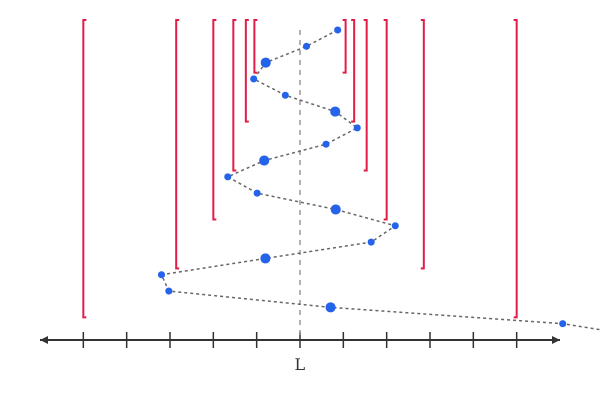
Now imagine the path it takes; that region it settles into must be bounded, because just as eventually (for some $N\in \mathbb{N}$) it will be less than $\varepsilon$ away from its destination, its limit, it is bounded on either side of the limit by a distance of $\varepsilon$. Prior to this (i.e. for $n < N$), it is not bounded, except that on any particular sequence it takes particular values $a_n$ for each $n < N$, and let us not forget that this moving dot moves not continuously but from each $a_n$ to the next $a_{n+1}$. As such, although it will have an infinite amount of time to move closer to its limit, it has only a finite amount of time (since $0 < n < N$) to get within $\varepsilon$ of its limit, and only a finite number of stops $a_1, a_2, ...$ before it does so. And as a finite number of particular points, we may simply draw a circle around them and bound them as well. So we conclude that any sequence that converges will have the entire path it takes bounded as well.
Conversely, if a sequence is bounded but not necessarily converging, then it has an infinite number of points $a_n$ to stop at and only a finite amount of space to place them. Those points have to go somewhere, and by skipping the points that do not move closer to some infinite collection of points, we can find a subsequence which converges even if the main sequence itself does not.
By similar reasoning, we can also say that a sequence which has an upper bound but is monotonic increasing must keep going up yet only has a finite amount of up it is allowed to go; it may not necessarily stop somewhere, but it must either stop or make its movements upwards slow down until the manner of its movements look like a convergence, and so the upper-bounded monotonic increasing sequence must too converge.
There is one more extremely valuable insight we can glean from this kind of pictoral thinking. There is a sort of parallel criterion to the limit, another thing we could prove which is ultimately the same as proving convergence which may be easier to prove sometimes. That is, the same way we picture a sequence jumping from $a_n$ to $a_{n+1}$ until it is bounded in a region around its convergence, it must also be bounded around its own path. If a sequence were to converge, one should hope that the steps it takes should get smaller and smaller over time, and so we can imagine a converging sequence as not just being $\varepsilon$ away from its limit, but perhaps $\varepsilon$ away from its next point and all points after that.
This notion of a 'region of convergence' is not merely imaginary, but to substantiate it, we will need to learn more strange things about the real numbers, which we will do in the next section. Once we do, we will find that it is a concept of utmost importance.
Now let us translate these intuitive deductions into formal ones.
Let $(a_n)$ be a sequence and $(b_n)_{n\in \mathbb{N}}$ be a subsequence which converges to $b\in \reals$. Then if $(a_n)_{n \in \mathbb{N}}$ to $a \in \reals$, we have $a = b$.
This follows directly from the previous proposition, and is in some sense a direct restatement of subsequences preserving limits. In fact it is somewhat difficult to prove this explicitly since in order to propose a fault from which to proceed with proof by contradiction, one must begin with something that is so blatantly false on its face that the rest of the proof by contradiction is not particularly necessary.
If a sequence converges, then it is bounded. That is, if $(a_n)_{n\in \mathbb{N}}$ is a sequence which converges to $a$, then there exists some $b_- \in \reals$ and some $b_+ \in \reals$ which satisfy $$\begin{gather*} b_- \le a_n \le b_+ \end{gather*}$$ for all $n\in \mathbb{N}$.
Proof.
We formalize almost exactly the story we told above. For some $\varepsilon > 0$ we have that there exists $N \in \mathbb{N}$ such that when $n \ge N$, $|a_n - a| \le \varepsilon$, since by hypothesis $(a_n)_{n\in \mathbb{N}}$ converges. Then fix some choice of $\varepsilon > 0$ (although the particular choice does not matter) so that it implies the existence of an appropriate $N \in \mathbb{N}$ with the properties we expect for convergence. We'll set a variable $\hat{b}_+ = \sup\{|a_n - a| \mid n \ge N \}$ to be the largest distance, $|a_n - a|$, the sequence takes from its limit when $n \ge N$; this means $a + \hat{b}$ will be greater than all $a_n$ after $n \ge N$.
Then $a+\hat{b}$ would be an upper bound for $(a_n)_{n\in \mathbb{N}}$ if not for the fact that some $a_n$ with $n < N$ might be greater than this upper bound; to fix this, we will define an upper bound for all $a_n$ before $n < N$, and we do this first by defining the set of points before $n < N$, $A_N = \{a_n \mid n < N\}$ (strictly this is not a set comprehension but an image of $\{n \in \mathbb{N} \mid n < N\}$ through the sequence acting as a function $a_\square \colon \mathbb{N} \to \reals$). With this set, we can take its maximum $\max(A_n)$ and either $\max(A_N)$ or $a+\hat{b}$ will be the upper bound for the entire sequence, so let us define $$\begin{gather*} b_+ = \max \big\{ \max(A_N), a+ \hat{b}_+ \big\} \end{gather*}$$
Since $A_N$ is literally contains $N - 1$ or less numbers, this quantity can be computed so long as we have a method to find $N$ from $\varepsilon$, which is guaranteed by hypothesis of convergence. The corresponding proof to calculate $b_-$, the lower bound, is exactly the same but with minimums instead of maximums and $a - \hat{b}$. $$\begin{gather*} b_- = \min \big\{ \min(A_N), a - \hat{b} \big\} \end{gather*}$$
Let $(a_n)_{n\in \mathbb{N}}$ be a sequence which is bounded above and monotone increasing, i.e. $a_n \le a_{m}$ for all $m,n \in \mathbb{N}$ satisfying $m \ge n$, and there exists $b\in \reals$ for which $a_n \le b$ for all $n \in \mathbb{N}$. Then $(a_n)_{n\in \mathbb{N}}$ must converge.
Proof.
Once again, we take the story we told and formalize it. Let $A = \{ a_n \mid n\in \mathbb{N} \}$ be the unordered set of all $a_n$ in the sequence. Since the set is bounded and non-empty, it has a supremum by the axiom of completeness, and we call this $s = \sup(A)$.
Now we aim to show that $s$ is the limit of $(a_n)_{n \in \mathbb{N}}$. For any $\varepsilon > 0$ we are given, there must exist some $a^* \in A$ which satisfies $s - \varepsilon \le a^* \le s$, since if no such $a^* \in A$ existed in this range then the least upper bound would be $s - \varepsilon$ not $s$. Now, since $A$ is the set of all $a_n$ in the sequence, $a^* \in A$ means there must exist some $N \in \mathbb{N}$ for which $a^* = a_N$, where $N$ is the $n$ which indexes the particular $a^*$ we pulled out of the sequence. Then since $(a_n)_{n\in \mathbb{N}}$ is monotonic increasing, we have for all $n \ge N$ that $$\begin{gather*} s - \varepsilon \le a_N \le a_n \\[0em] s - \varepsilon \le a_n \end{gather*}$$ by transitivity of ordering. Now, if we add $\varepsilon - a_n$ to both sides of this inequality, we obtain $$\begin{gather*} s - \varepsilon + (\varepsilon - a_n) \le a_n + (\varepsilon - a_n) \\[0em] s - a_n \le \varepsilon. \end{gather*}$$ This is neat, because $s-a_n$ is ensured to be positive ($s$ is the supremum of the set of all points in the sequence, and thus is larger than all $a_n$) meaning $s - a_n = |s - a_n|$. Moreover, $|s-a_n| = |a_n - s|$ because the absolute value will undo any multiplication by $-1$ inside its argument. This means we get to write $$\begin{gather*} |a_n - s| \le \varepsilon \end{gather*}$$ and notice that this followed as an implication from $n \ge N$ (since we could not have written $s- \varepsilon \le a_n$ otherwise). Then we have proven the limit.
If you're interested, you should note something about the above proof. That is, unlike in previous examples, we did not actually find a method to produce $N$ for a given $\varepsilon > 0$. What we did instead was show that some $N$ exists, and indeed if you had a picture of a number line with all the points $a_n$ marked and numbered, you would certainly be able to look between $s-\varepsilon$ and $s$ and select some $a_n$ to become our $a_N$. But instead, we selected our $a_N$ ultimately using the axiom of choice.
A sequence satisfies the Cauchy criterion if it satisfies the following property:
for all $\varepsilon > 0$, there exists $N \in \mathbb{N}$ such that for all $m,n \ge N$, we have $|a_m - a_n| \le \varepsilon$.
When this is true of a sequence, we call it a Cauchy sequence.
It is worth noting something about the Cauchy criterion, which is that it is not exactly a formal statement that ‘the steps the sequence takes get smaller over time’ as I said earlier. Instead it is that any two points in the sequence have shorter distances over time, since indeed all $m,n \ge N$ will satisfy $|a_m - a_n| \le \varepsilon$. Or one could read this as the statement that the sequence gets closer to the rest of itself over time.
This criterion is in some sense parallel to our existing definition of limit convergence; at this stage we have not proven that the Cauchy criterion has anything formally to do with limits, and yet it has a very obviously similar propositional form. Given the stories we told earlier, we can intuitively conclude some more things which we should formalize. For instance, if the sequence converges 'to itself', then for similar reasons as discussed earlier for convergent sequences, it should also be bounded. And as we discussed above, a sequence which does converge should then be Cauchy.
Let $(a_n)_{n\in \mathbb{N}}$ be a Cauchy sequence. Then the sequence is bounded.
Let $(a_n)_{n\in \mathbb{N}}$ be a sequence which converges to $a \in \reals$. Then the sequence is Cauchy.
Proof.
Since the sequence is assumed Cauchy, we may pick any $\varepsilon > 0$ (the choice does not matter) and the Cauchy assumption says that there must exist some $N \in \mathbb{N}$ for which all $m,n \ge N$ has $|a_m - a_n| \le \varepsilon$. Now fix a choice of $m$ (again the particular choice does not matter). The proof will now proceed very similarly to the proof of proposition seqlimsinR.8.
Let $$\begin{gather*} \hat{b} = \sup\{|a_m - a_n| \mid n \ge N\} \end{gather*}$$ be the supremum difference $a_m$ from all other elements of the sequence $a_n$ with $n \ge N$ (i.e. the value which bounds all other differences, the largest and then some perhaps). Then $a_m + \hat{b}$ forms an upper bound for the sequence of elements $n \ge N$.
Since $n$ is a counting number in $\mathbb{N}$, it is non-negative and thus any $n < N$ is also $0 < n < N$, meaning once again that the set of elements $a_n$ which come before $N$ are finite of length $N-1$ or less. Let's call this set $B = \{ a_n \mid n < N \}$ (once again, this is not technically a set comprehension but an image of one), so either $\max(B)$ or $a_m + \hat{b}$ will now bound the sequence. Our upper bound is then $$\begin{gather*} b_+ = \max \big\{ \max(B), a_m + \hat{b} \big\} \end{gather*}$$ and by a similar argument, our lower bound is $$\begin{gather*} b_+ = \min \big\{ \min(B), a_m - \hat{b} \big\}. \end{gather*}$$
Since the sequence is assumed to converge, let us say we are given some $\varepsilon > 0$ not in the sense of an epsilon that proves convergence but in the sense of an epsilon that proves it is Cauchy. Since we have the limit $a_n \to a$ as $n \to \infty$, we may also set two epsilons $\varepsilon_m,\varepsilon_n = \varepsilon/2$, each half of the epsilon we are given. For each of these epsilon, since $(a_n)_{n\in \mathbb{N}}$ converges, they each induce some $N$ which we call $N_m, N_n \in \mathbb{N}$, both such that when $m \ge N_m$ or $n \ge N_n$ we have $$\begin{gather*} |a_m - a| \le \varepsilon_m \\[0em] |a_n - a| \le \varepsilon_n \end{gather*}$$ respectively. Note also that $N_m = N_n$ since $\varepsilon_m = \varepsilon_n = \varepsilon/2$. Now we can apply the triangle inequality on the values $a_m, a_n, a \in \reals$. We obtain $$\begin{gather*} |a_m - a_n| \le |a_m - a| + |a_n - a|. \end{gather*}$$ Now consider that since $(a_n)_{n\in \mathbb{N}}$ converges, both terms $|a_m - a|$ and $|a_n - a|$ obey the relations above (each being less than $\varepsilon_m = \varepsilon_n = \varepsilon/2$) when $n \ge N_m = N_n$. For each of these, we may add a missing term to both sides by translation of orderings ($|a_n - a|$ to the first and $\varepsilon_m$ to the other) $$\begin{gather*} |a_m - a| + |a_n - a| \le \varepsilon_m + |a_n - a| \\[0em] \varepsilon_m + |a_n - a| \le \varepsilon_m + \varepsilon_n \end{gather*}$$ to construct the transitive sequence $$\begin{gather*} |a_m - a_n| \le |a_m - a| + |a_n - a| \le \varepsilon_m + |a_n - a| \le \varepsilon_m + \varepsilon_n \end{gather*}$$ which is $$\begin{gather*} |a_m - a_n| \le \varepsilon_m + \varepsilon_n = \frac{\varepsilon}{2} + \frac{\varepsilon}{2} = \varepsilon \end{gather*}$$ meaning that $$\begin{gather*} |a_m - a_n| \le \varepsilon \end{gather*}$$ as desired. Thus the $N \in \mathbb{N}$ we wished to prove existed for a given $\varepsilon> 0$ was in fact the same $N \in \mathbb{N}$ induced by our limit when we used $\varepsilon/2$ for convergence. When $n \ge N = N_m = N_n$, we have $|a_m - a_n| \le \varepsilon$, satisfying the Cauchy criterion.
The above proofs are minimized by default since many of them appear at once; I highly recommend that you take a look at them but if you read them in order, you may begin to notice the proofs repeating themselves a little here. What are beginning to appear are proof techniques, recurring patterns that are useful to us when we need to prove something. If indeed you are trying to follow along with exercises or trying to reproduce these proofs yourself (an exercise of its own that I highly recommend) then these techniques will be indispensible to you. Before long, the particular techniques we use will find their applications few and far between, as we package up each of their implications into theorems which we apply to greatly simplify the process.
We will shortly be able to prove that Cauchy sequences always converge in $\reals$, but to do so (and indeed for the nature of the proof to be meaningful to us) we will need some additional structures which we are yet to discuss. Accordingly, we postpone both the proof of this and the proof that bounded sequences have convergent subsequences until the following section, when we are able to discuss the formal reality of a region of convergence.
We close this section instead with some properties of limits that bare a resemblance to the real numbers. That is, in much the same way that real numbesr are defined with addition, subtraction, multiplication, ordering, and an Archimedean property, we will see that we can do most of these things for limits.
All these will be discussed and proven in the section appendix.
3. Section Appendix: The Limit is a Homomorphism
In the following chapter we will spend much of our focus on algebraic properties. These can be difficult to understand as the algebraic frame of mind is far removed from that of analysis, much less the frame of analytic geometry that most people encounter as highschool mathematics. However we have in fact already met these concerns when we discussed real numbers and the limit of a sequence.
That is, one first encounters the term algebra to refer to the ways in which one manipulates symbols standing for numbers using rewrites related to addition, subtraction, multiplication, and division. But this new structure we have introduced, the sequence, can also have these notions since they are related to real numbers. That is, for any sequences $(a_n)_{n\in \mathbb{N}}$ and $(b_n)_{n\in \mathbb{N}}$, it is clear certainly that we can define a new sequence $(c_n)_{n\in \mathbb{N}}$ which is either $c_n = a_n + b_n$, $c_n = a_n - b_n$, $c_n = a_n b_n$, or when $b_n \neq 0$ for all $n \in \mathbb{N}$, even $c_n = a_n / b_n$.
The question then appears; we have an operation, the limit, which can turn some sequences (those that converge) into real numbers, but how much structure does it preserve? Which manipulations can we do to sequences before will take the limit will remain after we take the limit? Can we ensure that $\lim_{n \to \infty} c = \left( \lim_{n \to \infty} a_n \right) + \left( \lim_{n \to \infty} b_n \right)$?
The question we are ultimately asking is "is the limit homomorphic", the formal name for asking if the function we are discussing preserves the features and structure of its input when it becomes an output. Since both sequences and real numbers can be added, subtracted, multiplied, and divided, there is indeed a lot of structure that the limit could potentially preserve, and if it does, this would grant us a great many tools in proofs going forward.
In fact it is true that the limit is homomorphic in a sense; our notion of division must surely be weakened since in order to preserve the structure of a division, the divisor must never be zero. But this is still enough to satisfy the requirements for a partially ordered ring homomorphism, a map that preserves the structures of addition, subtraction, multiplication and ordering, but not division. Strictly speaking it preserves even more structure than that, but that is certainly the neatest existing class of homomorphism we can put the limit in. In practice, one rarely thinks of the limit in this way with relation to algebraic rings, but rather focus on exactly the structure preservation we are about to discuss with each preserved feature in mind individually.
The implication of this however, if you wish to dwell on it, is that there is something number-like about convergent sequences of real numbers, much in the way we expect real numbers to function as numbers
Let us begin to show this.
Let $(a_n)_{n\in \mathbb{N}}$ and $(b_n)_{n\in \mathbb{N}}$ be two sequences which converge to $a$ and $b$ respectively. Then we have the following.
The sequence defined $c_n = k a_n$ for any constant $k \in \reals$ converges to $\lim_{n \to \infty} c_n = ka$. If we write this without $c_n$, this is $$\begin{gather*} \lim_{n \to \infty} (k a_n) = k \left( \lim_{n \to \infty} a_n \right) \end{gather*}$$
The sequence defined $c_n = a_n + b_n$ converges to $\lim_{n \to \infty} c_n = a + b$. If we write this without $c_n$, this is $$\begin{gather*} \lim_{n \to \infty} (a_n + b_n) = \left( \lim_{n \to \infty} a_n \right) + \left( \lim_{n \to \infty} b_n \right) \end{gather*}$$
The sequence defined $c_n = a_n b_n$ converges to $\lim_{n \to \infty} c_n = a b$. If we write this without $c_n$, this is $$\begin{gather*} \lim_{n \to \infty} (a_n b_n) = \left( \lim_{n \to \infty} a_n \right) \left( \lim_{n \to \infty} b_n \right) \end{gather*}$$
When $b_n \neq 0$ for all $n\in \mathbb{N}$ and $b \neq 0$, the sequence defined $c_n = a_n / b_n$ converges to $\lim_{n \to \infty} c_n = a/b$. If we write this without $c_n$ and the requirements are met, this is $$\begin{gather*} \lim_{n \to \infty} \frac{a_n}{b_n} = \frac{\lim_{n \to \infty} a_n }{\lim_{n \to \infty} b_n} \end{gather*}$$
Note here that a specific carve out is made for division, since it has additional requiremets, but not for subtraction; in place of subtraction we have scalar multiplication, since it is then possible to set $k = -1$ for part a and use it on conjunction with part b to define $c_n = a_n + (-1)b_n = a_n - b_n$.
Proof.
Let us first notice what we know and what we need to prove. We know $(a_n)_{n\in \mathbb{N}}$ and $(b_n)_{n\in \mathbb{N}}$ converge to $a$ and $b$ respectively, so for each of them we have a way to find $N_a$ and $N_b$ for any given $\varepsilon_a$ or $\varepsilon_b$ we choose, satisfying the rest of the limit properties. We are proving convergence of $(c_n)_{n\in \mathbb{N}}$ so we presume we are given some $\varepsilon_c > 0$ and need to find $N_c \in \mathbb{N}$ such that when $n \ge N_c$, we have the appropriate absolute value difference smaller than $\varepsilon$.
For $\varepsilon_c > 0$, we must find $N_c \in \mathbb{N}$ such that when $n \ge N_c$, we have $|ka_n - k a| \le \varepsilon_c$. So set $\varepsilon_a = \varepsilon_c / k$; by convergence of $(a_n)_{n\in \mathbb{N}}$, we have that when $n \ge N_a$, we have $$\begin{gather*} |a_n - a| \le \varepsilon_a = \frac{\varepsilon_c}{k} \end{gather*}$$ so we may merely multiply both sides by $k$ to obtain $$\begin{gather*} k|a_n - a| \le k \left( \frac{\varepsilon_c}{k}\right) \\[0em] |k a_n - k a| \le \varepsilon_c \end{gather*}$$ by distributivity and the property $k |a| = |ka|$ of absolute values. This means that $c_n = k a_n \to k a$ as $n \to \infty$ as we desired to show.
For $\varepsilon_c > 0$, we must find $N_c \in \mathbb{N}$ such that when $n \ge N_c$, we have $$\begin{gather*} |(a_n + b_n) - (a + b)| \le \varepsilon_c. \end{gather*}$$ So set $\varepsilon_a, \varepsilon_b = \varepsilon_c/2$ so that they induce $N_a,N_b \in \mathbb{N}$ each with $$\begin{gather*} n \ge N_a \implies |a_n - a| \le \varepsilon_a = \frac{\varepsilon_c}{2}, \\[0em] n \ge N_b \implies |b_n - b| \le \varepsilon_b = \frac{\varepsilon_c}{2}. \end{gather*}$$ Set $N_c = \max\{N_a,N_b\}$ so that both $n \ge N_a$ and $n \ge N_b$ are satisfied when $n \ge N_c$. Now we apply the triangle inequality on the values $(a_n -a),(b_n - b), 0 \in \reals$ and obtain $$\begin{gather*} |(a_n - a) - (b_n - b)| \le |(a_n - a) - 0 | + |(b_n - b) - 0| \end{gather*}$$ which we may easily rearrange some terms to turn it into $$\begin{gather*} |(a_n + b_n) - (a + b)| \le |a_n - a| + |b_n - b|. \end{gather*}$$ Now we may translate our existing relations which are true when $n \ge N_c$ by $|b_n - b|$ and $\varepsilon_a$ respectively $$\begin{gather*} |a_n - a| + |b_n - b| \le \varepsilon_a + |b_n - b| \\[0em] \varepsilon_a + |b_n - b| \le \varepsilon_a + \varepsilon_b \end{gather*}$$ and this forms the transitive sequence $$\begin{align*} |(a_n + b_n) - (a + b)| &\le |a_n - a| + |b_n - b| \\[0em] &\le \varepsilon_a + |b_n - b| \\[0em] &\le \varepsilon_a + \varepsilon_b \\[0em] &= \frac{\varepsilon_c}{2} + \frac{\varepsilon_c}{2} \\[0em] &= \varepsilon_c \end{align*}$$ which is exactly our desired $$\begin{gather*} |(a_n + b_n) - (a + b)| \le \varepsilon_c \end{gather*}$$ when $n \ge N_c$. We are done.
For any $\varepsilon_c > 0$ that we are given, we want some $N_c \in \mathbb{N}$ such that $|(a_n b_n) - a b| \le \varepsilon_c$. Let us say that we choose some $\varepsilon_a, \varepsilon_b > 0$ related to $\varepsilon_c$, but for now it is better to postpone explaining what we will set them too since an excellent choice will become obviously shortly. If $\varepsilon_a$ and $\varepsilon_b$ are chosen then they induce $N_a,N_b \in \mathbb{N}$ such that for each $n \ge N_a$ and $n \ge N_b$, we have $|a_n - a| \le \varepsilon_a$ and $|b_n - b| \le \varepsilon_b$. Set $N_c = \max\{N_a,N_b\}$ once again so that both $n \ge N_a$ and $n \ge N_b$ are satisfied when $n \ge N_c$.
Apply the triangle inequality on the elements $b_n(a_n - a)$, $a (b - b_n)$ and $0 \in \reals$. We obtain $$\begin{gather*} |b(a_n - a) - a(b - b_n)| \le |b_n(a_n - a) - 0| + |a (b - b_n) - 0| \end{gather*}$$ rearranging terms and simplying to $$\begin{gather*} |a_n b - a b_n + a b_n - ab| \le |b_n| |a_n - a| + |a||b_n - b|, \\[0em] |a_n b - a b| \le |b_n| |a_n - a| + |a| |b_n - b|. \end{gather*}$$ A mess of symbols though this might seem, we have a trick up our sleeves in proposition seqlimsinR.8. Since $(b_n)_{n\in \mathbb{N}}$ converges we know it has a bound $B \in \reals$ such that $|b_n| \le B$ for all $n \in \mathbb{N}$. We can focus on individual terms of the above inequality to see where $B$ applies $$\begin{gather*} |b_n| |a_n - a| \le B |a_n - a| \end{gather*}$$ which we know by taking $|b_n| \le B$ and dilating it by a factor $|a_n - a|$, and we can then translate this by $|a| |b_n - b|$ to obtain $$\begin{gather*} |b_n| |a_n - a| + |a| |b_n - b| \le B |a_n - a| + |a| |b_n - b|. \end{gather*}$$ We can apply this transitively on our old relation then to obtain $$\begin{gather*} |a_n b - a b| \le B |a_n - a| + |a| |b_n - b| \end{gather*}$$ We are now ready to define $\varepsilon_a = \varepsilon_c/2B$ and $\varepsilon_b = \varepsilon_c/2|a|$, since neither $B$ nor $a$ rely on a choice of $n$ or $N$ or anything downstream of our pretending we had already chosen $\varepsilon_a$ and $\varepsilon_b$. There is one problem with this though, which is that $|a|$ could be zero ($B$ can not, think about why) but in this case set $\varepsilon_b = \varepsilon_c / 2$ and use by transitivity $0 = |a||b_n - b| \le 1 \cdot |b_n - b|$.
Now recall that we started with $n \ge N_c$ implies $|a_n - a| \le \varepsilon_a$ and $|b_n - b| \le \varepsilon_b$. These are now $$\begin{gather*} |a_n - a| \le \varepsilon_a = \frac{\varepsilon_c}{2B}, \\[0em] |b_n - b| \le \varepsilon_b = \frac{\varepsilon_c}{2 |a|}, \end{gather*}$$ or equivalently by dilations, $$\begin{gather*} B |a_n - a| \le \frac{\varepsilon_c}{2}, \\[0em] |a||b_n - b| \le \frac{\varepsilon_c}{2}. \end{gather*}$$ We'll skip the obvious step of translating these so that they appear in the obvious forms for a transitive sequence since we've done that a few times now, but needless to say we now have $$\begin{gather*} |a_n b_n - a b| \le B |a_n - a| + |a| |b_n - b| \le \frac{\varepsilon_c}{2} + \frac{\varepsilon_c}{2} = \varepsilon_c, \\[0em] |a_n b_n - a b| \le \varepsilon_c \end{gather*}$$ which is exactly what we wanted to prove. Since this is true whenever $n \ge N_c$, we know that $a_n b_n \to a b$ when $n \to \infty$. We are done.
Part d follow trivially from part c so long as we first prove that $(d_n)_{n\in \mathbb{N}}$ defined $d_n = 1/b_n$ converges to $1/b$, since then we can say $a_n d_n \to a(1/b) = a/b$ as $n \to \infty$.
To do that, we will need to employ some unusual techniques in the proving of a limit. We will need to show that for all $\varepsilon_d > 0$ there exists some $N_d \in \mathbb{N}$ such that when $n\ge N_d$, $|1/b_n - 1/b| \le \varepsilon_d$; first notice something about the term $|1/b_n - 1/b|$. We know that $(b_n)_{n\in \mathbb{N}}$ converges, and so we know that there exists some $N_b$ for when $\varepsilon_b = |b|/2$ we will be able to write $$\begin{gather*} |b_n - b| \le \varepsilon_b = \frac{|b|}{2}. \end{gather*}$$
Recall in lemma realnumsax.13.e we showed that $|a| \le k$ satisfies $-k \le a \le k$ so we'll use that now on $|b|/2$ and $b_n - b$. This gives us $$\begin{gather*} -\frac{|b|}{2} \le b_n - b \le \frac{|b|}{2}. \end{gather*}$$ Now consider that $|b|$ is either $b$ or $-b$ depending on whether $b$ is positive or negative, and depending on those two cases, this sequence of inequalities is one of the following: $$\begin{gather*} -\frac{b}{2} \le b_n - b \le \frac{b}{2}, \\[0em] \frac{b}{2} \le b_n - b \le -\frac{b}{2}. \end{gather*}$$ We will see that despite not knowing which is true, the structure of the inequality means that we can say something regardless; in either case, add $b$ to both sides to obtain one of the two $$\begin{gather*} \frac{b}{2} \le b_n \le \frac{3b}{2}, \\[0em] \frac{3b}{2} \le b_n \le \frac{b}{2}. \end{gather*}$$ Now consider what happens to the ordering if we take the absolute value: the absolute value operation $x \mapsto |x|$ is a monotonic increasing function $x \mapsto x$ when its argument is greater than or equal to zero, meaning that in the first case the order is preserved, but it is a monotonic decreasing function $x \mapsto -x$ when its argument is less than or equal to zero, which flips the orderings, meaning both cases result in $$\begin{gather*} \frac{|b|}{2} \le |b_n| \le \frac{3|b|}{2}. \end{gather*}$$ This entire inequality is of some interest to us, since it says that at some point, when $n \ge N_b$ for some $N_b$ induced by a choice $\varepsilon_b = |b|/2$, we will have $|b_n$ less than $|b|/2$ away from $|b|$ but specifically we need the first part, $$\begin{gather*} \frac{|b|}{2} \le |b_n|. \end{gather*}$$ Moreover, if we say $n \ge N_d$ for some $N_d$ we specify shortly, and $N_d \ge N_b$, then we will have $n \ge N_d \ge N_b$, and thus $n \ge N_b$, implying that $|b|/2 \le |b_n|$ also. Once again, this is all downstream of the fact that $|b|/2$ is itself $|b|/2$ away from $|b|$, and at some point $|b_n|$ must get close enough to $|b|$ that it cannot be more than $|b|/2$ away in the course of its convergence on $b$.
This may at first seem like a strange fact, since we have not previously explored setting $\varepsilon$ for known limits to some specific value in order to obtain specific inequalities, but it remains a valid one, and is indeed vital for the rest of the proof.
Now say we are given some $\varepsilon_d > 0$ and we need to find $N_d \in \mathbb{N}$ such that when $n \ge N_d$, we have $|1/b_n - 1/b| \le \varepsilon$. Set $\varepsilon_b = |b|^2 \varepsilon_d / 2$ so that it induces some $N_b$, but importantly, if this $N_b$ induced by $\varepsilon_b = |b|^2 \varepsilon_d / 2$ is smaller than the $N_b$ induced by $\varepsilon_b = |b|/2$, take the larger $N_b$ to be our $N_d$ so that it is always true that $|b_n| \ge |b|/2$.
Now observe we can do some manipulations on the fractions in $|1/b_n - 1/b|$, $$\begin{align*} \left|\frac{1}{b_n} - \frac{1}{b} \right| &= \left|\frac{b}{ b b_n} - \frac{b_n}{b b_n} \right| \\[0em] &= \left|\frac{b - b_n}{ b b_n} \right| \\[0em] &= \frac{|b - b_n|}{ |b| |b_n|}. \end{align*}$$ We can now apply $|b|/2 \le |b_n|$ on this by inverting the inequality, which we recall is a monotonic decreasing function $x \mapsto 1/x$ so we flip the ordering and write $2/|b| \ge 1/|b_n|$. This new inequality, dilated on both sides by $|b-b_n|/|b|$ is exactly the form above, and gives us $$\begin{gather*} \left|\frac{1}{b_n} - \frac{1}{b} \right| = \frac{|b - b_n|}{ |b| |b_n|} \le \frac{2|b_n - b|}{|b|^2}. \end{gather*}$$ Presuming that $n \ge N_d$ and $N_d = N_b$ or $N_d > N_b$ depending on what we chose earlier, we know that $n \ge N_b$ and thus $|b_n - b| \le \varepsilon_b$ is satisfied. Dilating this on both sides by $2/|b|^2$ it is $$\begin{gather*} \frac{2|b_n - b|}{|b|^2} = \left( \frac{2}{|b|^2} \right) \big( |b_n - b| \big) \le \left( \frac{2 }{|b|^2} \right) ( \varepsilon_b ) \end{gather*}$$ but we had set $\varepsilon_b = |b^2| \varepsilon_d / 2$ so we have $$\begin{gather*} \left|\frac{1}{b_n} - \frac{1}{b} \right| \le \frac{2|b_n - b|}{|b|^2} \le \left( \frac{2 }{|b|^2} \right) \left( \frac{|b^2| \varepsilon_d}{2}\right). \end{gather*}$$ Cancelling some terms in our fractions on the right and ignoring the middle of this transitive inequality, we have $$\begin{gather*} \left|\frac{1}{b_n} - \frac{1}{b} \right| \le \varepsilon_d \end{gather*}$$ as we had desired.
I highly recommend looking over the above proof for any techniques which are unfamiliar, since there are a few there we haven't used before.
It must be noted that while all numbers can be compared in $\reals$, this is not the case for sequences since it is entirely possible for two sequences to have, say $a_1 > b_1$ but $a_2 < b_2$ for different parts of the sequence $n=1$ or $n=2$ respectively. This is what it means to be partially ordered; in a partially ordered set, objects can be ordered but not reliably. Some objects will be incomparable with one another as is the case in sequences.
The point of the Order Limit Theorem will be that when such an ordering does exist, it is preserved under the limit.
Let $(a_n)_{n\in \mathbb{N}}$ and $(b_n)_{n\in \mathbb{N}}$ be sequences converging to $a$ and $b$ respectively. If $a_n \le b_n$ for all $n\in \mathbb{N}$ then $a \le b$. That is, $$\begin{gather*} \forall n\in \mathbb{N}, (a_n \le b_n) \implies \left( \lim_{n\to \infty} a_n \right) \le \left(\lim_{n\to\infty} b_n\right) \end{gather*}$$
Proof.
This time we are not proving a limit, but rather purely trying to get the inequality $a \le b$ from knowing that $a_n \to a$ and $b_n \to b$ as $n \to \infty$ and $a_n \le b_n$ for all $n \in \mathbb{N}$. First, set $\varepsilon_a$ and $\varepsilon_b$ both to the value $\varepsilon_a,\varepsilon_b = |a-b|/3$ and set $N = \max\{N_a, N_b\}$ the maximum of the two. And since $\varepsilon_a = \varepsilon_b$, it will become prudent to refer to them interchangably so let them both be written $\varepsilon$. So we have $$\begin{gather*} |a_n - a| \le \varepsilon = \frac{|a- b|}{3} \\[0em] |b_n - b| \le \varepsilon = \frac{|a- b|}{3} \end{gather*}$$ when we assume $n \ge N$.
We start by applying lemma realnumsax.13.e to these inequalities, obtaining $$\begin{gather*} -\varepsilon \le a_n - a \le \varepsilon \\[0em] - \varepsilon \le b_n - b \le \varepsilon \end{gather*}$$ from which we take the left inequality from the first line, multiplying by $-1$ and adding $a_n$ to both sides, and the right inequality of the second line adding $b + \varepsilon$ to both sides. $$\begin{gather*} a \le a_n + \varepsilon \\[0em] b_n + \varepsilon \le b + 2\varepsilon \end{gather*}$$ Since we have $a_n \le b_n$ for all $n\in \mathbb{N}$, we also have $a_n + \varepsilon \le b_n + \varepsilon$, which gives us the transitive sequence $$\begin{gather*} a \le a_n + \varepsilon \le b_n + \varepsilon \le b + 2\varepsilon \\[0em] a \le b + 2\varepsilon. \end{gather*}$$ We can subtract $b$ from both sides and divide by two to isolate $\varepsilon$ before expanding to its form as $|a-b|/3$, obtaining $$\begin{gather*} \frac{a-b}{2} \le \frac{|a-b|}{3}. \end{gather*}$$ Note at this point that since no value in this inequality depends on $n$, despite the fact that we implied it from $n \ge N$, it must be true always since it does not change when $n$ is changed, and indeed it is always possible to set $n \ge N$ since $(a_n)_{n\in \mathbb{N}}$ and $(b_n)_{n\in \mathbb{N}}$ converge.
We now have three cases to consider. By the trichotomy of ordering, $a-b$ is either $a-b < 0$, $a-b = 0$ or $a-b > 0$. We'll call these cases (1), (2) and (3).
In case (1), $a-b < 0$ implies $a < b$ by adding $b$ to both sides, which is exactly what we wanted to prove.
In case (2), $a-b = 0$ implies $a = b$ by adding $b$ to both sides, and this is a subcase of $a \le b$ which is literally $(a<b)\wedge(a = b)$, so once again the theorem is proven in this case.
Case (3) gets a bit weirder, since assuming $a-b > 0$ and thus $a > b$ also implies $|a-b| = a-b$, the inequality we have above can be rewritten by manipulations on fractions, $$\begin{gather*} \frac{a-b}{2} \le \frac{a-b}{3} \\[0em] \frac{a-b}{2} - \frac{a-b}{3}\le 0 \\[0em] \frac{3(a-b)}{6} - \frac{2(a-b)}{6}\le 0 \\[0em] \frac{a-b}{6}\le 0 \\[0em] a-b\le 0 \end{gather*}$$ but this is in contradiction with our assumption that $a- b > 0$, so we can assume that this case never occurs.
This means that only cases (1) or (2) never happen, and thus $a \le b$ is always true when $a_n \le b_n$ for all $n\in \mathbb{N}$.
In the following section, our discussion on regions of convergence will make it intuitively obvious that the 'regions' that $(a_n)_{n\in \mathbb{N}}$ and $(b_n)_{n\in \mathbb{N}}$ converge in are obviously non-overlapping eventually when $a < b$, and thus that $a < b$ has to be true.
As promised above, the following theorem will be our very rough analogy to the Archimedean principle for limits. That is, it says nothing about infinitessimals, however in the same way that showing no infinitessimals exists means that two numbers are presumed equal if you cannot find a number between them, this theorem will say that a sequence must converge if it is bounded on either side by sequences which together converge on the same limit between them. In this way, a sequence is squeezed into convergence.
When last I was taking graduate mathematics class, my peers and I still considered this theorem a relevant one which we would mention by name, a testament to its enduring usefulness.
Let $(a_n)_{n\in \mathbb{N}}$, $(b_n)_{n\in \mathbb{N}}$ and $(c_n)_{n\in \mathbb{N}}$ be sequences, where $a_n \to a$ and $c_n \to a$ as $n\to \infty$. If $a_n \le b_n \le c_n$ for all $n\in \mathbb{N}$, then $(b_n)_{n\in \mathbb{N}}$ also converges to $a$.
Proof.
Say we are given some $\varepsilon_b > 0$ in the course of proving its limit. Set $\varepsilon_a$ and $\varepsilon_c$ to $\varepsilon_a,\varepsilon_c = \varepsilon_b$ and $N_b = \max\{N_a,N_c\}$ so that when $n \ge N_b$, we have $$\begin{gather*} |a_n - a| \le \varepsilon_a = \varepsilon_b, \\[0em] |c_n - a| \le \varepsilon_c = \varepsilon_b. \end{gather*}$$ We'll now apply a similar technique to the one from the order limit theorem proof, applying lemma realnumsax.13.e both times to get $$\begin{gather*} - \varepsilon_b \le a_n - a \le \varepsilon_b, \\[0em] - \varepsilon_b \le c_n - a \le \varepsilon_b \end{gather*}$$ where we take the left hand inequality of the first line and add $a$ to both sides, and take the right hand inequality on the second line and add $a$ to both sides, getting $$\begin{gather*} a - \varepsilon_b \le a_n, \\[0em] c_n \le a + \varepsilon_b. \end{gather*}$$ Since by assumption we have $a_n \le b_n \le c_n$ for all $n\in \mathbb{N}$, we can add these inequalities to the transitive chain and obtain $$\begin{gather*} a - \varepsilon_b \le a_n \le b_n \le c_n \le a + \varepsilon_b \\[0em] a - \varepsilon_b \le b_n \le a + \varepsilon_b \\[0em] - \varepsilon_b \le b_n - a\le \varepsilon_b \end{gather*}$$ which now lets us use the other direction of lemma realnumsax.13.e to obtain $$\begin{gather*} |b_n - a| \le \varepsilon_b \end{gather*}$$ as desired when $n \ge N_b$. We are done.