Intervals in $\mathbb{R}$ and Limit Characterizations
In this section it is pertinant to stop and examine the properties of real numbers again, as it turns out that the axiom of completeness has much more significant consequences than its mere statement might suggest. That is, we have mentioned many times in the previous section the notion of a 'region of convergence', and while we have formally discussed the idea of 'convergence', we have not yet formally discussed the notion of a 'region'.
Such a concept is deceptively complicated, as it cuts to the heart of what separates the discrete regime of numbers from continuous mathematics, and more importantly, is at the heart of why it is meaningful for us to speak of numbers as a model for geometry at all. The real numbers are constructed with the intention that they have no gaps. In mathematics, we speak about this property positively and instead say that "the real numbers are complete". There are multiple criteria for completeness (which in certain hairsplitting settings even disagree quite badly) but for the purposes of real analysis we are generally concerned with Cauchy completeness.
In fact Cauchy completeness is exactly the property that in a space, all Cauchy sequences converge, a property that we will return to in many settings since it is profoundly non-trivial. Consider for instance the set of rational numbers, the numbers formed from fractions of integers, $\mathbb{Q}$. Obviously numbers such as $\sqrt{2}$ are not included in such a set, and yet it is easy to construct a sequence of rational numbers that converges to an irrational. In fact it is relatively easy using the reasoning of the monotone convergence theorem to simply imagine a sequence of only rational numbers which is monotonic increasing but bounded above by $\sqrt{2}$ (since irrational numbers and rational numbers may be placed on the same ordered axis) which is at every point rational and yet always approaching an irrational number; for $\pi$ there is even a game of finding successively better rational approximations, first $22/7$, then $355/113$, so on and so on. It is possible to speak of such a sequence converging and yet it must converge to something outside of the space it is defined in, that of the rationals.
It is precisely because we have the axiom of completeness that we may point to a subset of the rational numbers, bounded above by a number which is not itself rational and thus a 'gap' as far as the rationals are concerned, and fill that gap with whatever needs to be there to complete the space with a supremum of the set. There are far greater elaborations on these concepts that we can make but they will have to wait for the coming sections of this chapter. For now, we should actually find out what a region is in our $\reals$ conception of 'space'.
1. Intervals and some promised Theorems
We begin our study of 'regions' with the notion of an interval. Formally, the word 'line' refers to a line that does not end in either direction; if it stops in one direction but continues indefinitely in the other then we call it a 'ray', and if it ends in both directions and thus has finite length, we call it a 'segment'. Obviously, if we are concerned with the real number line then we may speak of real number segments, and that is exactly what is described by an interval. Just as you think of a segment of time as beginning at one specified moment and ending at another, we can set a beginning and an end for an interval to define a very basic space.
A set $I \subset \reals$ is called an open interval if there exists two numbers $a,b \in \reals$ such that $$\begin{gather*} I = \{x \in \reals \mid a < x < b\} \end{gather*}$$ i.e. the interval is all of the points between $a$ and $b$ but not including them. We then write as notation $$\begin{gather*} (a,b) := \{x \in \reals \mid a < x < b\}. \end{gather*}$$ We may also use this notation on open intervals such as $\{x \in \reals \mid x < b\}$ or $\{x \in \reals \mid a < x\}$, writing $$\begin{gather*} (-\infty,b) := \{x \in \reals \mid x < b \} \\[0em] (a , \infty) := \{x \in \reals \mid a < x \} \\[0em] (-\infty, \infty) := \reals \end{gather*}$$ which we shall think of as making sense since this notation distinctly does not include $-\infty$ or $\infty$, and thus only deals with real numbers.
A set $I \subset \reals$ is called a closed interval if there exists two numbers $a,b \in \reals$ such that $$\begin{gather*} I = \{x \in \reals \mid a \le x \le b\} \end{gather*}$$ i.e. the intterval is all of the points between $a$ and $b$ and including them. We then write as notation $$\begin{gather*} [a,b] := \{x \in \reals \mid a \le x \le b\} \end{gather*}$$ which thus allows one to write $[a,a] = \{a\}$ for a singleton set. There is also mixed interval notation $$\begin{gather*} [a,b) := \{x \in \reals \mid a \le x < b \} \\[0em] (a , b] := \{x \in \reals \mid a < x \le b \} \end{gather*}$$ since the curved parentheses denote not including the endpoint and the square bracket denotes including the endpoint.
I should tell you if you become interested in other mathematics texts that many authors will write open intervals not as $(a,b)$ but rather as $]a,b[$ to imply that those endpoints are taken by some imaginary closed intervals on either side of the open interval.
It is also worth noting that this notation comes along with a certain responsibility, which is that when using it, we have to be certain that $(a,b)$ or $[a,b]$ indeed has $a < b$ or $a \le b$ respectively. This does not necessarily mean that at every point we write an interval in a proof we pause to show that the interval is a valid one (unless for some reason that should be necessary) but it is a case where the tools of our reasoning can be fallable. In fact this particular responsibility has probably never lead any major particular error, but it remains a good example of things we have to keep track of that simultaneously validate our thought process but are written only because we are certain they are true. For instance, neither can we write $\lim_{n \to \infty} a_n$ if $(a_n)_{n\in \mathbb{N}}$ is not a sequence which converges, and there will be many instances where it is tempting to look at a sequence and simply think of $\lim_{n \to \infty}$ as a function on sequences, when it is only a function on convergent sequences.
But this is our first look at a region, and it is immediate that we can do some things with such a definition. In fact, since intervals can be thought of like segments, then we might consider their length; we have been using $|a - b|$ as the distance between two points $a$ and $b$ since it is the magnitude of their difference. Now recall what a limit describes: we say that the points in a sequence beyond some $N \in \mathbb{N}$ are $|a_n -a| \le \varepsilon$ which is the same as $$\begin{gather*} - \varepsilon \le a_n - a \le \varepsilon \end{gather*}$$ by lemma realnumsax.13.e and thus also $$\begin{gather*} a - \varepsilon \le a_n \le a + \varepsilon. \end{gather*}$$ But the set of points $x$ satisfying this condition in place of $a_n$ would then be an interval $[a - \varepsilon, a + \varepsilon]$ since they are the same statement. This is our first observation about the role of 'regions' in convergence.
Let $a,b,c \in \reals$ and $c \ge 0$. Then we have the following equivalences of statements.
$|a - b| \le c$ if and only if $a \in [b - c, b + c]$
if $c \neq 0$ then $|a - b| < c$ if and only if $a \in (b - c, b + c)$
Proof.
Apply lemma realnumsax.13.e as mentioned above. Immediately our statements on absolute values are recognized as equivalent to $$\begin{gather*} -c \le a - b \le c \\[0em] -c < a - b < c \end{gather*}$$ respectively. We can of course add $b$ in both cases immediately to obtain $$\begin{gather*} b -c \le a \le b + c \\[0em] b -c < a < b + c \end{gather*}$$ for the two cases. If we define sets $I$ and $\bar{I}$ (distinguished by the presence of the bar above one) as $$\begin{gather*} \bar{I} = [b - c, b + c] = \{x \in \reals \mid b - c \le x \le b + c\} \\[0em] I = (b - c, b + c) = \{x \in \reals \mid b - c < x < b + c\} \end{gather*}$$ then the statement $b -c \le a \le b + c$ is equivalent to $a \in \bar{I}$ and the statement $b -c < a < b + c$ is equivalent to $a \in I$. So we have showed the implication, however all of our steps of reasoning were reversible, so we have shown the implication in both directions.
Combining lemma openlimsR.2 and lemma realnumsax.13.e one immediately concludes that for all $a,b\in \reals$, $|a| \le c$ if and only if $a \in [-c, c]$, and $|a| < c$ if and only if $a \in (-c,c)$.
From lemma openlimsR.2 it follows that the statement of the limit for a sequence $(a_n)_{n\in \mathbb{N}}$
for all $\varepsilon > 0$ there exists $N \in \mathbb{N}$ such that $n \ge N$ implies $|a_n - a| \le \varepsilon$
is equivalent to the statement
for all $\varepsilon > 0$ there exists $N \in \mathbb{N}$ such that $n \ge N$ implies $a_n \in [a - \varepsilon, a + \varepsilon]$.
With this mental tool in hand, it now becomes pertinant to ask certain questions. For instance, in the section appendix of the previous section we presented the order limit theorem, showing that two convergent sequences which retain an ordering for all $n \in \mathbb{N}$ will continue to satisfy that ordering in their limit. But we may also consider the interval between them. We can now finally ask about limits not of numbers but of sets, with infinite intersections or infinite unions.
Let $(a_n)_{n\in \mathbb{N}}$ and $(b_n)_{n\in \mathbb{N}}$ be sequences with the property that $a_n \le b_n$ for all $n\in \mathbb{N}$ and the closed intervals defined $I_n = [a_n,b_n]$ satisfy $I_{n+1} \subseteq I_n$, i.e. $(a_n)_{n\in \mathbb{N}}$ is monotonic increasing and $(b_n)_{n \in \mathbb{N}}$ is monotonic decreasing such that each successive interval is smaller and contained in the previous one. Then, defining the appropriate notation as below, the set $$\begin{gather*} \bigcap_{n\in \mathbb{N}} I_n := \lim_{n\to\infty} \bigcap_{i=1}^n I_i \end{gather*}$$ is a nonempty set. In other words, the intersection of any sequence of successively nested intervals is non-empty.
Proof.
We may immediately notice that all of the requirements for the monotone convergence theorem are satisfied for both $(a_n)_{n\in \mathbb{N}}$ and $(b_n)_{n\in \mathbb{N}}$, so we know that they converge to values $a$ and $b$ in $\reals$ respectively. Moreover, the order limit theorem then immediately tells us that these $a$ and $b$ satisfy $a \le b$.
Now let us inspect the statement we wish to prove. Since the intervals are nested, we have that each intersection is equal only to the smallest interval in the intersection operation, which is the $I_\square$ with highest $i$. Recalling the big operator notation, for $\bigcap_{i = 1}^n I_i$, this highest $i$ is itself $n$, so $\bigcap_{i = 1}^n I_i = I_n$. Another way of saying this is that since $I_{i+1}$ is the set of points $x$ which satisfy $a_{i+1} \le x \le b_{i+1}$ then by transitivity, $$\begin{gather*} a_i \le a_{i+1} \le x \le b_{i+1} \le b \end{gather*}$$ meaning $a_i \le x \le b$ are automatically satisfied by transitivity on both sides, i.e. $I_i \cap I_{i+1} = I_{i+1}$. And this remains inductively true, i.e. we may count up or down as many times as we want and still find that the deepest nested interval is the only one remaining from the intersection.
This means that $$\begin{align*} \bigcap_{n\in \mathbb{N}} I_n = \lim_{n\to\infty} \bigcap_{i=1}^n I_i &= \lim_{n\to\infty} I_n \\[0em] &= \lim_{n\to\infty} [a_n,b_n] \\[0em] &= \lim_{n\to\infty} \big\{ x\in \reals \mid a_n \le x \le b_n \big\}. \end{align*}$$
It may here seem difficult to proceed, since we do not have an obvious rule that allows us to pass a limit inside a set. We do however have a way to pass a limit to an inequality via the order limit theorem, and we can apply this on $a_n \le x$ and $x \le b_n$ separately to produce a transitive chain. All that we require to do such a thing is to reinterpret each $x \in \reals$ as a sequence $(x_n)_{n \in \mathbb{N}}$ for which $x_n = x$ for all $n\in \mathbb{N}$, i.e. each $(x_n)_{n\in \mathbb{N}}$ is a constant sequence which is always equal to the value of $x \in \reals$ we care about. Consequently each such sequence converges trivially to its corresponding $x$. Then each $x \in \reals$ may apply the order limit theorem and deduce that $a_n \le x_n$ and $x_n \le b_n$ implies $a \le x$ and $x \le b$, thus $a \le x \le b$. Since we can apply this for all $x \in \reals$, we have in a sense performed a transformation on the condition that $x$ is defined to satisfy in $I_n$. So just as in the order limit theorem we wrote $$\begin{gather*} \forall n\in \mathbb{N}, (a_n \le b_n) \implies \left( \lim_{n\to \infty} a_n \right) \le \left(\lim_{n\to\infty} b_n\right) \end{gather*}$$ we will now write $$\begin{align*} \lim_{n\to\infty} \big\{ x\in \reals \mid a_n \le x \le b_n \big\} &= \big\{ x\in \reals \mid \lim_{n\to\infty} a_n \le x \le \lim_{n\to\infty} b_n \big\} \\[0em] &= \big\{ x\in \reals \mid a \le x \le b \big\} \\[0em] &= [a,b]. \end{align*}$$
This alone is not the statement that $\bigcap_{n\in \mathbb{N}} I_n$ is non-empty, however $a \le b$ is either $a < b$ or $a = b$. In the former case $[a,b]$ is clearly non-empty since it includes $(a+b)/2$ or any other number between. In the latter case it remains non-empty as we have effectively applied the squeeze theorem, concluding $\bigcap_{n\in \mathbb{N}} I_n = [a,a]$ which is the singleton set $\{a\}$, containing itself and thus non-empty.
In fact this property, which once elaborated even a little seems obvious, is exactly what we need to complete two proofs promised in the previous section.
We had said that a sequence which is bounded has an infinite number of points to place and only a finite amount of space to put them, and so it should make sense that at least some subsequence of the set does converge. We had also said that it should make sense that Cauchy sequences converge, a fact which we will then be able to prove.
Every bounded sequence has a converging subsequence.
It is my understanding that when you are unable to type the character “ß”, the second most correct way to refer to this theorem is as Bolzano-Weierstrass. Not even wikipedia refers to it with this character, however it is common amongst mathematical texts to spell the theorem's name with the proper character.
Proof.
Let $(a_n)_{n\in \mathbb{N}}$ be our bounded seequence, and since it is bounded, there exists some $b\in \reals$ such that $a_n \in [-b,b]$ for all $n\in \mathbb{N}$; this is not to imply that each $a_n$ is particularly close to zero, but rather in the way that you would say a bounded sequence has $b_- \le a_n \le b_+$ for some much tighter bound, we simply take $b = \max\{|b_-|,|b_+|\}$ and in the same way $|a_n| \le b$, we say $a_n \in [-b,b]$ by corollary openlimsR.3.
We now proceed by binary search, much in the same way one would search an ordered list, to find some infinite collection of points which can form a converging subsequence. Since $(a_n)_{n\in \mathbb{N}}$ is an infinite sequence, there are infinite elements of the sequence in $[-b,b]$ since all $a_n \in [-b,b]$. We call $I_0 = [-b,b]$.
Now one of the two intervals $[-b,0]$ or $[0,b]$ will have the property that there does not exist a $N \in \mathbb{N}$ with the property that $n \ge N$ implies $a_n$ is not in the interval, and we call this interval $I_1$. In other words, this interval $I_1$ which is either $[-b,0]$ or $[0,b]$, has the property that there is no final $a_n \in I_1$, and so there does not exist a $N \in \mathbb{N}$ that would allow $n \ge N$ to imply $a_n \notin I_1$. This is since $(a_n)_{n\in \mathbb{N}}$ is infinite and must put its sequence elements somewhere, so $I_1$ is the interval out of the two that does continue indefinitely to contain elements $a_n$. It is our narrowing region of convergence.
Repeating this operation, assume we had picked $I_1 = [0,b]$ (although of course the operation is very similar if we had not), we then pick $I_2$ as either $[0,b/2]$ or $[b/2,b]$, depending on which interval has the property that there does not exist a rank $N\in \mathbb{N}$ after which $n \ge N$ fails to find any $a_n \in I_2$.
We are thus inductively defining a sequence of nested intervals $(I_n)_{n\in \mathbb{N}}$ where each $I_n$ always fails to find a 'final' sequence element within it, and thus has infinite sequence elements within. Writing these intervals as $I_n = [x_n,y_n]$ we define the sequence of bounds $(x_n)_{n\in \mathbb{N}}$ and $(y_n)_{n\in \mathbb{N}}$, which are for example $x_1 = 0$, $x_2 = b/2$ and $y_1 = b$, $y_2 = b$, etc. with $x_n \le y_n$ for all $n\in \mathbb{N}$. By the nested interval property, we know that $\lim_{n\to\infty} I_n$ is a non-empty set, so we choose some $$\begin{gather*} c \in \left[ \lim_{n\to\infty} x_n, \lim_{n\to\infty} y_n \right] \end{gather*}$$ and define a corresponding subsequence $(c_n)_{n\in \mathbb{N}}$ such that each $c_n$ is equal to the $a_m \in I_n$ with the smallest $m \ge n$ possible to satisfy $a_m \in I_n$. In this way we respect the subsequence property that the $\varphi\colon \mathbb{N}\to\mathbb{N}$ that defines $c_n = a_{\varphi(n)}$ is monotonic increasing, since the smallest $m\ge n$ such that $a_m \in I_n$ will either be excluded in $I_{n+1}$, be excluded since $m\ge n$ fails to be $m \ge n+1$, or simply remain in place until it is displaced as described.
Our goal now becomes to show that $c_n \to c$ as $n \to \infty$, since we have identified a subsequence and must now show that it is convergent. We will do this using the squeeze theorem, squeezing $(c_n)_{n\in \mathbb{N}}$ between $(x_n)_{n\in \mathbb{N}}$ and $(y_n)_{n\in \mathbb{N}}$.
Observe first that by construction, each $I_{n+1}$ has length half that of $I_n$, as we saw that $I_0 = [-b,b]$ and we split the interval in half so that $I_1$ is either $[-b,0]$ or $[0,b]$, etc. and since $I_n = [x_n,y_n]$, this means we may write $$\begin{gather*} |x_n - y_n| = \frac{b}{2^{n-1}} \end{gather*}$$ since $[-b,0]$ and $[0,b]$ both have interval length $b$ at $I_1$, we see as well here that setting $n=1$ produces a length $|x_1 - y_1| = b$. But this is also $$\begin{gather*} |x_n - y_n| = (2b) 2^{-n} \end{gather*}$$ and the right hand side should be familiar to us. In example seqlimsinR.4 we showed that $2^{-n} \to 0$ as $ n\to \infty$. By the algebraic limit theorem, we also know that $(2b) 2^{-n} \to 0$ as $n\to \infty$ since we are merely scaling the limit by $2b$. This tells us that the distance between $x_n$ and $y_n$ converges to zero, or that in the limit they should be the same number, and thus $[x,y]$ is a singleton set, $\{c\}$, but we should show that explicitly.
We know that $x_n \le y_n$ for all $n\in \mathbb{N}$ so $|x_n - y_n| = y_n - x_n$, and we know that $y_n$ by construction is monotonic decreasing and $x_n$ is monotonic increasing (once again, consider that the intervals are nested) so with $c \in [x,y]$, the limit of the interval-nesting, we may say $x_n \le x \le c \le y \le y_n$. This transitive chain implies that $x_n - c \ge 0$ and $y_n - c \le 0$ (which should be obvious, since $c$ is between $x_n$ and $y_n$) but we may also consider this a different way: $$\begin{gather*} 0 \le c - x_n \le y_n - x_n \\[0em] 0 \le y_n - c \le y_n - x_n \end{gather*}$$ and we know this to be true since $c \ge x_n$ (as above, implying the $0 \le c - x_n$) and we may merely subtract $x_n$ from both sides of $c \le y_n$ (as above), and for the second inequality chain we may take $c \ge x_n$ and derive $-c \le -x_n$, adding $y_n$ to both sides. However we know that the expressions on the right $y_n - x_n$ converge to zero, so by squeeze theorem, we have $c - x_n \to 0$ and $y_n - c \to 0$ as $n \to \infty$, which by the algebraic limit theorem is the same as saying $x_n \to c$ and $y_n \to c$ as $n\to \infty$.
Now since $(c_n)_{n\in \mathbb{N}}$ is defined such that each $c_n$ is chosen from $[x_n,y_n]$, we have by construction $$\begin{gather*} x_n \le c_n \le y_n \end{gather*}$$ for all $n\in \mathbb{N}$ with both $x_n \to c$ and $y_n \to c$ as $n \to \infty$. This satisfies the requirements for the squeeze theorem to say $c_n \to c$ as $n \to \infty$.
With this in hand, we will be able to apply Bolzano-Weierstraß together with the property of preservation of limits under subsequences and the boundedness of Cauchy sequences to say, hey, a cauchy sequence is bounded so it has a convergent subsequence with some limit, and the Cauchy sequence must get infinitely close to the rest of itself and thus to its subsequence, which also converges. That means it gets infinitely close to the same limit as its subsequence and converges!
All Cauchy sequences converge.
Proof.
Let $(a_n)_{n\in \mathbb{N}}$ be our Cauchy sequence. By proposition seqlimsinR.11, it is bounded, and this satisfies the requirements for Bolzano-Weierstraß implying there is a subsequence $(b_n)_{n\in \mathbb{N}}$ of $(a_n)_{n\in \mathbb{N}}$ and we call this limit $b \in \reals$. Our goal becomes to show that for all $\varepsilon_L > 0$ ($L$ for limit) there exists $N_L \in \mathbb{N}$ such that $n\ge N_L$ implies $|a_n - b| \le \varepsilon_L$.
To show this, let us start with the assumption that $(a_n)_{n\in \mathbb{N}}$ is Cauchy, and so for any $\varepsilon_C > 0$ ($C$ for Cauchy) there exists $N_C \in \mathbb{N}$ such that $n,m \ge N_C$ implies $|a_n - a_m| \le \varepsilon_C$, and the assumption that $(b_n)_{n\in \mathbb{N}}$ converges, for all $\varepsilon_b > 0$ there exists $N_b \in \mathbb{N}$ such that $n \ge N_b$ implies $|b_n - b| \le \varepsilon_b$.
So assuming we are given some $\varepsilon_L$, set $\varepsilon_b, \varepsilon_C = \varepsilon_L/2$ and set $N_L = \max\{N_b,N_C\}$. This means that when $n,m \ge N_L$, we have both $$\begin{gather*} |b_n - b| \le \varepsilon_b = \frac{\varepsilon_L}{2},\\[0em] |a_n - a_m| \le \varepsilon_C = \frac{\varepsilon_L}{2}. \end{gather*}$$ Moreover, since we may choose $m,n \ge N_L$, let us say that $m = \varphi(n)$ where $\varphi\colon\mathbb{N}\to\mathbb{N}$ is the monotonic increasing map that defines the subsequence $b_n = a_{\varphi(n)} = a_m$. This means that the latter inequality above is $$\begin{gather*} |a_n - b_n| \le \varepsilon_C = \frac{\varepsilon_L}{2}. \end{gather*}$$ This is exactly what we need to apply the triangle inequality on $a_n,b_n,b \in \reals$, yielding $$\begin{gather*} |a_n - b| \le |a_n - b_n| + |b_n - b|. \end{gather*}$$
We'll skip the bells and whistles as we have gotten more familiar with them in previous proofs: since we know $|a_n - b_n| \le \varepsilon_C$ and we know $|b_n - b| \le \varepsilon_b$, we'll replace them both in one transitive step which is obvious to us now.$$\begin{gather*} |a_n - b_n| + |b_n - b| \le \varepsilon_C + \varepsilon_b. \end{gather*}$$ But recall we set $\varepsilon_C$ and $\varepsilon_b$ to $\varepsilon_L/2$ so they sum together to form $\varepsilon_L$. This gives us the transitive chain $$\begin{gather*} |a_n - b| \le |a_n - b_n| + |b_n - b| \le \varepsilon_C + \varepsilon_b = \varepsilon_L \\[0em] |a_n - b| \le \varepsilon_L \end{gather*}$$ but this is exactly the form of the limit we wanted, so we are done.
It is worth noting how short this proof is, considering how important it will be to us and how we had first suspected this theorem might be true a whole section ago. In fact, most of the heavily lifting in this proof was done by applying theorems which were proved in the previous section, with the exception of Bolzano-Weierstraß. Our theory is developing to the point where we are able to rapidly make meaningful statements about our constructions using the framework we have built up rather than constantly resorting to first principles. This is in many ways the pattern of a mathematical theory. The pattern we see here will become less starkly apparent as we move on however, since as we build up different theories they will begin to refer to one another in a much more interconnected way rather than merely a single theory building on itself.
2. Open and Closed Sets and the Topological Limit
We have however only scratched the surface of our discussion of space, and we have tiptoed into it using the notion of an interval to describe the idea of a region. But the way in which we have called our intervals open or closed is a far more general property of regions than mere intervals. In fact they will continue to prove fundamental for many chapters to come.
Our exploration of openness and closedness will remain in $\reals$ in this section as we use $\reals$ as an example to demonstrate their properties and their uses. Quickly it will become apparent that the exclusion or inclusion of end-points of an interval are perhaps the least interesting things about open and closed sets. In fact, if we are to ask what our motivations are here, why we are investigating this notion of "openness" or "closedness" at all, it is because these properties turn out to be deeply intrinsically linked with the features of limits.
Let $A \subseteq \reals$ be some set. We say that $A$ is an open set if for any point $a \in \reals$, there exists $\varepsilon > 0$ such that the open interval $I = (a - \varepsilon, a + \varepsilon)$ is contained in $A$, $I \subseteq A$. When a set $B \subset \reals$ has the property that there exists some open set $A \subseteq \reals$ which is its set compliment, i.e. $$\begin{gather*} B = \reals \setminus A = \{b\in \reals \mid b \notin A\} \end{gather*}$$ then we call $B$ a closed set.
Since closed sets here are defined by the space being absent an open set (indeed this was also noted when we mentioned the $]a,b[$ open interval notation), we shall focus on open sets first. Immediately we should look at this definition and ask if it generalizes what we want it to, i.e. are open intervals actually open sets? Well let's look closely at the definition.
The property stated is that an open set only contains points which it can place an open interval around within itself. At first this statement might sound strange, but remember that open intervals do not contain their end points. If we are to assume for a moment that open sets also do not contain endpoints, then any point we pick in an open interval is not itself an endpoint and thus not on the boundary. If it is within the boundary, then there are points between itself and the boundary which can itself form a bound for an interval which is contained in the set. Thus the intuition is as in the diagram below.
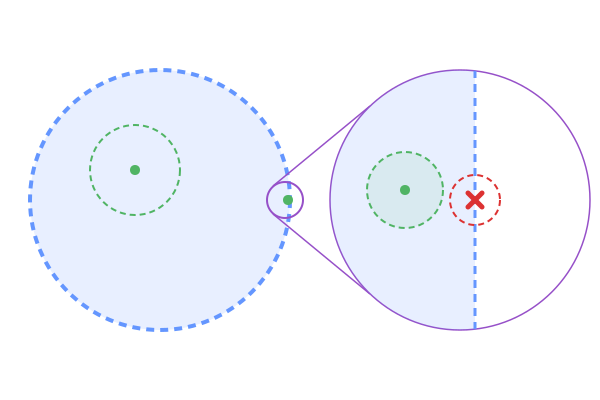
But we must not let ourselves think that this means open sets are merely open intervals. In $\reals$ (and particular in only one dimension) this is almost true. The particular caveat we make is that, since an open set must only have the property above, that every point in the open set has an interval containing it which is itself contained in the open set, there is nothing stopping us from saying that an open set contains disconnected components. For instance, if we have four numbers $a,b,c,d \in \reals$ with $a<b < c <d$ we may take the open intervals $(a,b)$ and $(c,d)$ and establish the open set $(a,b) \cup (c,d)$, the set containing all elements in either interval, and this is an example of an open set. The trick with this however is that open sets will sometimes be much stranger foam-like sets with perhaps infinite open intervals. The magic of this construction is that no matter how strange an open set we select, this particular statement of openness allows us to prove a lot of things without knowing the finer details of whatever infinite open-foam is going on in the open set. We simply know that every point in the set has an open interval around it.
We will be able to say much much more about closed sets shortly, but for now, since we have defined closed sets in $\reals$ as the absence of an open set in $\reals$, it is immediately apparent that since $(-\infty,a) \cup (b, \infty)$ is an open set, we also have its compliment $[a,b]$ the closed interval, as a closed set. Very roughly we can say that closed sets contain their end points in the way that closed intervals do, but the particular manner in which this works will have to be proven shortly.
Let $a,b \in \reals$ with $a< b$. Then $(a,b)$ is an open set and $[a,b]$ is a closed set.
Proof.
A point $c \in (a,b)$ allows us to choose $\varepsilon = \min\{c - a,b-c\}$, i.e. the distance between $c$ and the endpoint of the interval closer to $c$, thus having $(c - \varepsilon, c + \varepsilon) \subseteq (a,b)$. We should show this formally however, and to do that, we take the property of being in $(c - \varepsilon, c + \varepsilon)$, i.e. all $z \in (c - \varepsilon, c + \varepsilon)$ satisfy $c - \varepsilon <z < c + \varepsilon$ and show that it satisfies $ a < z < b$. Let us treat the inequalities separately, as $c - \varepsilon < z $ and $z < c + \varepsilon$. Then we manipulate these inequalities as follows. $$\begin{gather*} c-\varepsilon < z \implies c-z <\varepsilon \\[0em] z < c + \varepsilon \implies z - c < \varepsilon. \end{gather*}$$ Using $\varepsilon = \min\{c - a,b-c\}$, we know $\varepsilon \le c-a$ and $ \varepsilon \le b - c$, since $\varepsilon$ is the minimum of the two and thus either equal in the inequality or less than it, we may apply transitivity using the two different inequalities, $$\begin{gather*} c-z <\varepsilon \le c - a \\[0em] z - c < \varepsilon \le b - c \end{gather*}$$ deriving $$\begin{gather*} c-z < c - a \implies a < z\\[0em] z - c < b - c \implies z < b \end{gather*}$$ as desired. So we have shown that $c - \varepsilon <z < c + \varepsilon$ implies $a < z < b$, meaning $(c - \varepsilon, c + \varepsilon) \subseteq (a,b)$.
Every closed interval $[a,b]$ also has the open set $A = (-\infty,a) \cup (b, \infty)$ so that $[a,b] = \reals \setminus A$.
We must also acknowledge a sleight of hand. Our epsilon-N notion of a limit in the way we have been showing limits so far will begin to fail as we move deeper into mathematics, and that is because, in some sense, our definition is not the true one. We have relaxed a requirement, which is that we have said a limit is "for all $\varepsilon > 0$, there exists $N \in \mathbb{N}$ such that when $n \ge N$, we have $|a_n - a| \le \varepsilon$" and this relaxation is to be found in our use of $\ge$ and $\le$. In more general spaces, limits are proven using $> $ and $<$, so that the statement becomes "for all $\varepsilon > 0$, there exists $N \in \mathbb{N}$ such that when $n > N$, we have $|a_n - a| < \varepsilon$", and indeed the statement $|a_n - a| < \varepsilon$ is then the same as $a_n \in (a - \varepsilon,a + \varepsilon)$. We have relaxed this definition thus far because we can, that is, in $\reals$ at least it turns out that these definitions are equivalent, and because being able to do this makes proofs much much easier. However this will begin to fail as we move into other spaces, and as it fails and we are forced to narrate limits not as $a_n \in [a - \varepsilon,a + \varepsilon]$ but as $a_n \in (a - \varepsilon,a + \varepsilon)$, excluding endpoints, a fundamental property of open sets will become apparent very slowly. That is, the idea that limits converge at all and what they converge to is ultimately a property defined by open sets. In fact this is what topology, absent any algebraic concerns, priniciply does for us in analysis, but it will take many more sections before we are able to see this in its full glory.
Let $(a_n)_{n\in \mathbb{N}}$ be a sequence and $a \in \reals$ a number. Then the following statements are equivalent.
$\displaystyle{\lim_{n\to\infty} a_n = a}$
for all $\varepsilon > 0$, there exists $N\in \mathbb{N}$ such that for all $n \ge N$ we have $|a_n - a| \le \varepsilon$ (we will call this the relaxed limit)
for all $\varepsilon > 0$, there exists $N\in \mathbb{N}$ such that for all $n > N$ we have $|a_n - a| < \varepsilon$ (we will call this the proper limit)
for all open intervals $(x,y)$ such that $a \in (x,y)$, there exists some $N \in \mathbb{N}$ such that for all $n > N$, we have $a_n \in (x,y)$ (we will call this the region of convergence limit)
for all open sets $A \subseteq \reals$ such that $a \in A$, there exists some $N \in \mathbb{N}$ such that for all $n > N$, we have $a_n \in A$ (we will call this the topological limit)
Proof.
The first statement of the list is purely notational, and is defined as equivalent to the relaxed limit. Indeed, once the proof is complete, we will interpret this notation as describing any of the other definitions of convergence. We will now need to move through this list proving that each one implies another and vice versa until we have formed a full chain of bidirectional implications. Note that this proof will use heavy implicit use of corollary openlimsR.3.
We'll begin by assuming the relaxed limit and trying to show the proper limit. That is, we presume that for all $\varepsilon_1 > 0$, there exists $N_1$ such that for all $n \ge N_1$ we have $|a_n - a| \le \varepsilon_1$. We wish to prove that for all $\varepsilon_2 > 0$, there exists $N_2$ such that for all $n > N_2$, we have $|a_n - a| < \varepsilon_2$. So say we are given some $\varepsilon_2$. Set $\varepsilon_1 = \varepsilon_2/2$ so that it implies the existence of $N_1$, and choose $N_2 = N_1$. Since $\varepsilon_2 > 0$, it has the property that $\varepsilon_2 / 2 < \varepsilon_2$, that is, it is positive so its half is smaller than its whole. When we assume $n \ge N_2$, since $N_2 = N_1$, we have $|a_n - a| \le \varepsilon_1$, but by construction this is $$\begin{gather*} |a_n - a| \le \varepsilon_1 = \frac{\varepsilon_2}{2} < \varepsilon_2\\[0em] |a_n - a| < \varepsilon_2 \end{gather*}$$ as desired.
To prove the opposite direction, let us reverse our assumptions. Say we are given $\varepsilon_1$ and must find $N_1$ with the appropriate properties to satisfy the relaxed limit. Set $\varepsilon_2 = \varepsilon_1$ so that it induces $N_2$ and set $N_1 = N_2 + 1$. This means that $N_1 > N_2$, and in particular the property $n \ge N_1$ is $n \ge N_1 > N_2$ so $n > N_2$ is satisfied. When $n > N_2$ is satisfied, we have $|a_n - a| < \varepsilon_2 = \varepsilon_1$, but this is the same as $a_n \in (a - \varepsilon_1, a + \varepsilon_1)$. Obviously, this open interval is a subset of the corresponding closed interval, since the interval without endpoints fits inside the interval with its endpoints. This means we have implied $a_n \in [a - \varepsilon_1, a+ \varepsilon_1]$, but that is the same as saying $|a_n - a| \le \varepsilon_1$, which is what we wanted to prove.
For the next step, we show that the the proper limit is equivalent to the region of convergence limit. We'll reuse our numbers, saying that we wish to show "for all $\varepsilon_1 > 0$ there exists $N_1 \in \mathbb{N}$ such that for all $n > N$ we have $|a_n - a| < \varepsilon_1$" is the same as "for all open intervals $(x,y)$ such that $a \in (x,y)$, there exists some $N_2 \in \mathbb{N}$ such that for all $n > N_2$, we have $a_n \in (x,y)$". So presume the former and we will show the latter. That is, assume we are given some $(x,y)$ satisfying $a \in (x,y)$. Now choose $\varepsilon_1 = \min\{a - x, y - a\}$, since $a$ is $x < a < y$, so these numbers $a-x$ and $y-a$ are both positive, and in particular choosing the smaller of them in this way will mean that $$\begin{gather*} (a - \varepsilon_1, a + \varepsilon_1) \subseteq (x,y) \end{gather*}$$ We should prove this however. And the particular form of this proof will be that all $z \in (a - \varepsilon_1, a + \varepsilon_1)$ must also be $z \in (x,y)$. That is, we prove that any number satisfying the condition defining the subset satisfies the condition defining the proposed superset. First consider that $$\begin{gather*} (a - \varepsilon_1, a + \varepsilon_1) = (a - \varepsilon_1, \infty) \cap (-\infty, a + \varepsilon_1) \end{gather*}$$ in the sense that the restriction $a - \varepsilon_1 < z < a + \varepsilon_1$ may be decomposed into the two restrictions $a - \varepsilon_1 < z $ and $z < a + \varepsilon_1$. Since we define $\varepsilon_1 = \min\{a - x, y - a\}$, we have $\varepsilon_1 \le a - x$ and $\varepsilon_1 \le y - a$, since it is either equal to either of them or less than either one because it is the other one. So manipulating these individual conditions, $$\begin{gather*} a-\varepsilon_1 < z \implies a-z <\varepsilon_1 \\[0em] z < a + \varepsilon_1 \implies z - a < \varepsilon_1 \end{gather*}$$ we may apply transitivity using the two different inequalities, $$\begin{gather*} a-z <\varepsilon_1 \le a - x \\[0em] z - a < \varepsilon_1 \le y - a \end{gather*}$$ deriving $$\begin{gather*} a-z < a - x \implies x < z\\[0em] z - a < y - a \implies z < y \end{gather*}$$ and thus putting them together, we have shown $a - \varepsilon_1 < z < a + \varepsilon_1$ implies $x < z < y$. The corresponding statement on sets is that $(a - \varepsilon_1, a + \varepsilon_1) \subseteq (x,y)$ as desired. This means that $a_n \in (a - \varepsilon_1, a + \varepsilon_1)$, the same statement as $|a_n - a| < \varepsilon_1$ is the same as $a_n \in (x,y)$. But then if we choose the $N_2$ that we need to show exists to be $N_2 = N_1$, we have that for all $n > N_1 = N_2$, we have $|a_n - a| < \varepsilon_1$ which also implies $a_n \in (x,y)$ as desired.
To do the proof in the converse case is even easier, since we may pick any interval $(x,y)$ containing $a$ and find $N_2$ such that $n > N_2$ implies $a_n \in (x,y)$. So say we are given $\varepsilon_1$, we may simply pick $x = a - \varepsilon_1$ and $y = a + \varepsilon_1$. Choosing $N_1 = N_2$, the statement $n > N_1 $ implies $|a_n - a| < \varepsilon_1$ is now immediately the same as the statement we already know to be true, that $n > N_2$ implies $a_n \in (x,y) = (a - \varepsilon_1, a + \varepsilon_1)$ by corollary openlimsR.3.
For the final step of the proof, we must show that the region of convergence limit is the same as the topological limit. So we want to show that "for all open intervals $(x,y)$ such that $a \in (x,y)$, there exists some $N_1 \in \mathbb{N}$ such that for all $n > N_1$, we have $a_n \in (x,y)$" is the same as "for all open sets $A$ such that $a \in A$, there exists some $N_2 \in \mathbb{N}$ such that for all $n > N_2$, we have $a_n \in (x,y)$". So we'll presume that the sequence converges under the region of convergence limit and show that it converges under the topological limit. So say we are given some open set $A$ with $a \in A$; since it is an open set, there exists an open interval with $a \in I$ and $I \subseteq A$. So we'll take this interval $(x,y) = I$ to be the open interval for the region of convergence limit, and thus imply a $N_1$ such that $n > N_1$ implies $a_n \in (x,y) = I \subseteq A$, and thus $a_n \in A$. So setting $N_2 = N_1$, we have $n > N_2 = N_1$ implies $a_n \in A$ exactly as we wanted.
In the other direction, our proof is similarly simple. Since all open intervals are open sets, when we are given some $(x,y)$ with $a \in (x,y)$, we immediately set $A = (x,y)$ to induce some $N_2$ where $n > N_2$ implies $a_n \in A$. Setting $N_1 = N_2$, we have $n > N_1$ implying $a_n \in (x,y)$ since $a_n \in A = (x,y)$.
This proof in some sense shows how all along our use of $\varepsilon$ in proofs as a bound, a way of saying 'the distance between $a_n$ and $a$ is at least $\varepsilon$ small' was in fact a proxy for speaking about open sets. In the region of convergence limit and topological limit we see that we can similarly define limits not with a notion of 'small' defined by distance but rather by choosing our own small set. Recalling our earlier analogy about limits as checking a property with a measurement instrument at some resolution corresponding to $\varepsilon$, we lose the more obvious manner of improving our precision where we simply make $\varepsilon$ smaller (although indeed we can still simply scale down an open set) and instead gain the ability to check the precision in arbitrary other ways. For instance, where previously we had $|a_n - a| \le \varepsilon$ meaning that $a_n \in (a - \varepsilon, a + \varepsilon)$, this region of convergence could only be defined as centered around $a$, buffered by $\varepsilon$ on either side, but our region of convergence limit shows that in fact $a$ does not need to be the center of the interval, it only needs to be in the interval.
But most of all, this proof should perhaps inform us what is meant by an open set in general. In some sense, what we have shown above, the notion of open sets as a region within which a sequence converges, could be argued in a sense to be what open sets are for. Indeed we will show in a later section that in other kinds of spaces where notions of ordering or other ways of structuring the space no longer make sense, the notion of an open set still exists such that it remains meaningful to take limits. If someone asks you 'what is an open set' and you simply must reply in only two seconds, your mind should go to 'a set that can be used to define convergence'. And even when our notions of what sets count as open are radically distorted in future exampls, our definition of which sequences converge and to what limits will still be defined by those distorted notions of open sets, precisely because which sets count as open define limits in abstract.
Now, if we are to say that what we have just done is demonstrated the fundamental purpose of open sets, then it should make sense to immediately follow with the fundamental purpose of clsoed sets as we promised earlier. More specifically, if open sets are sets containing some limit point and the tail of an infinite sequence converging to that limit point, closed sets are sets which contain the limits corresponding to each and every sequence contained within them. If we take this to be what we think closed sets are, it immediately follows why closed intervals must contain their endpoints, since any monotone increasing sequence in the interval bounded by it must converge to the supremum, which must then be included, and vice versa for the infimum. You could also say that this is the reason why these sets are called closed, not in opposition to open sets, but in the same sense that a set $A$ may be closed under addition, meaning that $a,b\in A$ implies $a+b \in A$, closed sets are closed under limits, in that any sequences in the set converges to a point in the limit.
Let $B \subset \reals$ be a set. We say that a point $a \in B$ is a limit point of $B$ if there exists a sequence $(a_n)_{n\in \mathbb{N}}$ with $a_n \in B$ for all $n \in \mathbb{N}$ with $a = \lim_{n\to\infty} a_n$.
$B$ is then closed if and only if it contains all of its limit points.
Proof.
To prove that closed sets contain their limit points, we must proceed by contradiction. If $B$ is closed, then there exists an open set $A = \reals \setminus B$ which is open by definition. what we want to prove is that all sequences $(a_n)_{n\in \mathbb{N}}$ which are $a_n \notin A$ (and thus $a_n \in B$) have limits $a \notin A$ (and thus $a \in B$, meaning it contains its limit points) so our proof by contradiction will presume that there exists a sequence $(a_n)_{n\in \mathbb{N}}$ with $a_n \in B$ converging to $a \in A$ (a limit point which is not in $B$).
In fact the violation of a known fact occurs immediately. When we described the topological limit it was that for any open set $A$ containing the limit $a$, there exists a $N\in \mathbb{N}$ such that for all $n > N$, we have $a_n \in A$. And yet we have presumed that $a_n \notin A$ for all $n \in \mathbb{N}$, so there cannot exist any $N \in \mathbb{N}$ with that property, violating the assumption that $a_n \to a$ as $n \to \infty$. So such a sequence cannot exist, and all sequences in $B$ must converge in $B$.
For the converse, we proceed by proof of contradiction again. That is, we are trying to prove that if $B$ contains all its limit points, then the set $A = \reals \setminus B$ is an open set. So we'll presume for the sake of contradiction that $A$ is not open, i.e. there exists a point $z\in A$ for which no open interval centered on $z$ is contained in $A$, or equivalently, for every interval $I = (z - \varepsilon,z + \varepsilon)$, the intersection $I \cap B$ is nonempty.
Let $(x_n)_{n\in \mathbb{N}}$ and $(y_n)_{n\in \mathbb{N}}$ be sequences that both converge to $z$ with $z - x_n = y_n - z$, in effect defining by proxy a sequence $(\varepsilon_n)_{n\in \mathbb{N}}$ defining the nested intervals $(z - \varepsilon_n, z + \varepsilon_n) = (x_n,y_n)$, each candidate intervals which we would say are in $A$ if $A$ were open. As above, we stated that every interval containing $z$ intersects $B$, so every $(x_n,y_n) \cap B$ is non-empty, but this means that from each non-empty set $(x_n,y_n) \cap B$ we may choose some $a_n \in (x_n,y_n) \cap B$ to define a sequence $(a_n)_{n\in \mathbb{N}}$ which must also converge to $z$ due to the squeeze theorem (namely since $x_n < a_n < y_n$ and $x_n,y_n \to z$ as $n \to \infty$). What we have constructed then is a sequence $(a_n)_{n\in \mathbb{N}}$ which is $a_n \in B$ (since $a_n \in (x_n,y_n) \cap B$, i.e. $\big(a_n \in (x_n,y_n)\big) \wedge (a_n\in B) $) for all $n\in \mathbb{N}$ yet converges to $z \in A = \reals \setminus B$, i.e. $z \notin B$, contradicting the assumption that $B$ contains all its limit points. We conclude that $B$ must be closed.
Understanding this property, that closed sets are sets which are closed under limits, and that open sets are sets which sequences converge into and that contain intervals around their points, we can now ask if open and closed sets are even opposites. Obviously they are defined in such a way that a closed set is the absence of an open set, and yet these properties seem somewhat disconnected from each other. It is worth noting that it is indeed possible for a set to be either open and closed or neither open nor closed; the archetypal example of an open and closed set (colloquially clopen) is $\reals$ itself: just as we think of $\{a\} = [a,a]$ as a closed interval, we think of $\{\} = \emptyset = (a,a)$, the empty set, as open, thus $\reals = \reals \setminus \emptyset$ must be closed. Yet we also think of $\reals = (-\infty,\infty)$ so we think of it as open. Both $\emptyset$ and $\reals$ are then clopen sets. For a set which is neither open nor closed, take the rational numbers as a subset of the real numbers. The rational numbers are a collection of infinite points with no intervals, and so it cannot be open, and yet as discussed earlier, it does not contain limit points such as irrational numbers, so it is neither open nor closed.
3. Section Appendix: Some musings on Countability and Uncountability
(rewrite first draft here)